Around 600 years ago in Ferrara, Italy, an Inquisitor interrogated dozens of women cohabiting with supposedly celibate clergymen, leaving behind a register that detailed the investigation and its suspects. Centuries later, this court record became an unexpectedly enlightening document that shed light on medieval Italy’s social history.
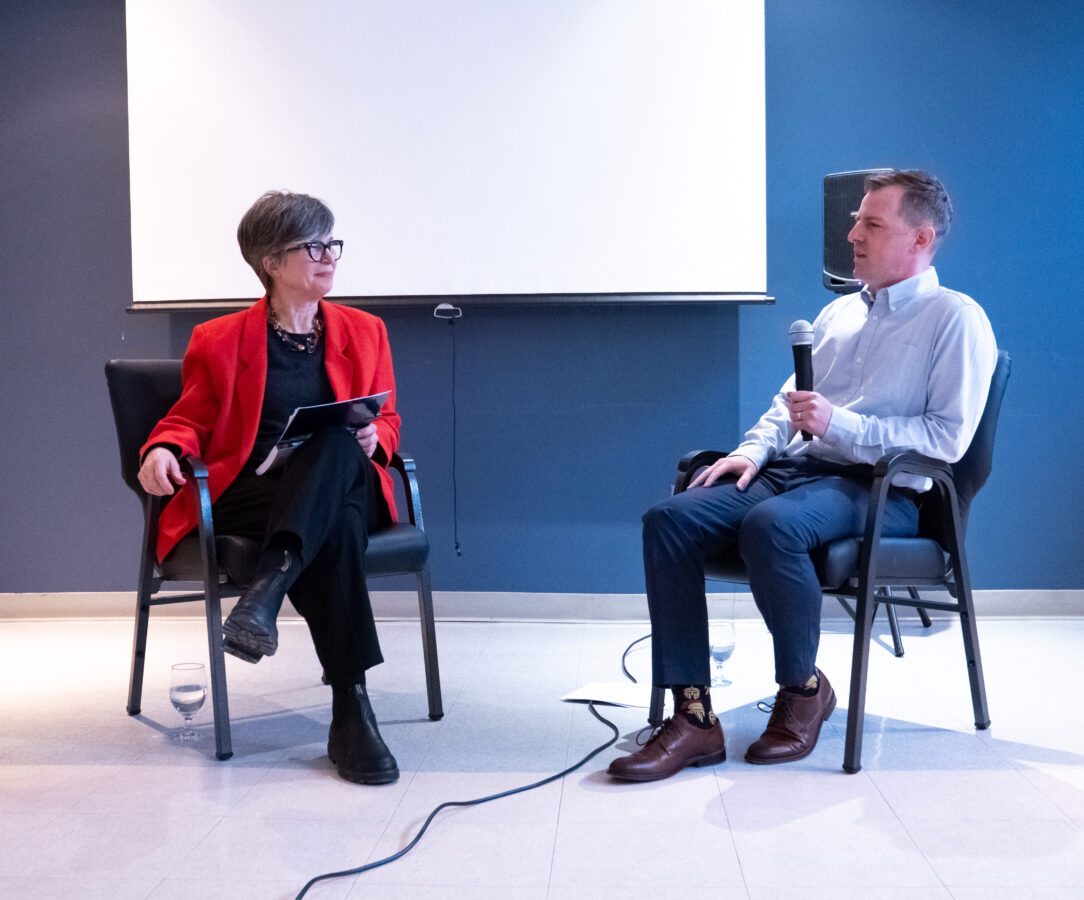
U of M medieval and early modern studies professor Roisin Cossar and department of history sessional instructor Jason Brown hosted a talk on March 5 at St. John’s College to mark the launch of Telling Tales: Clerics, Concubines, and an Inquisitor in Late Medieval Ferrara: A Primary Source Study, a book they co-authored exploring the Italian register.
The Inquisition, often led by Dominican friars on its front lines, was a series of tribunals launched by the Catholic Church to combat heresy in the 15th and 16th centuries. Many are no doubt familiar with Inquisitors from popular films such as The Name of the Rose starring Sean Connery or “The Spanish Inquisition” in Monty Python’s Flying Circus, but the records left by these investigators also offer a rare glimpse into the lives of the accused.
Cossar, a social historian whose focus is on medieval northern Italy, noted that the suspects in Ferrara would have been brought into court by the Inquisitors, questioned about their lives and living situations and then released. However, some of them, such as Doratea, did not get off the hook so easily.
“Doratea got on the Inquisitor’s radar in a more […] serious way, and she ends up being detained, being imprisoned and, in fact, being tortured by the Inquisitor’s team in order to get her to provide more information,” Cossar explained.
“She was someone who, as it turns out, had probably had a couple of different relationships with different clerics over the course of her life. And she was a woman in her 50s. She had a young daughter, she was very concerned about her daughter […] There’s a lot in her and in her testimony [that make] her particularly, I suppose, recognizable to us now.”
This register is the only known document on women in such predicaments, according to Cossar. The concubines lived with priests and took care of their households — some of them were practically wives, but others were more akin to servants. Regardless, this posed a problem to the Church since clerics are, in theory, allowed to have neither wives nor concubines. Many of the concubines were also middle aged or older, and the experience of aging before the modern period is still poorly understood.
“To have women in their 50s and their 60s and older […] telling us things about their work, about where they’re living, about the kinds of connections that they have, about their adult children and how their children support them, or they support their children, all of that is really interesting information,” Cossar commented.
“These women and these households, these essentially are the foundation for […] the clergy and for the Church […] They really prop up the Church in their communities because they allow, then, the priest to do his work because they’re doing all the domestic work and maintaining the household, and often providing stability for the cleric.”
Telling Tales is more than a straightforward analysis of a primary source, and the book offers several interpretations of the text, addressing both the Inquisitor and the women he investigated. The Inquisitor might have been seen as a judge, confessor or even a punisher, but there is also evidence to suggest the investigations were performative. Brown, who specializes in medieval Latin texts, transcribed and translated the register into English. He highlighted incidents where disciplinary action should have, but did not, take place.
“One [instance] was a woman named Beatrix who, unprompted, just in the course of talking with the Inquisitor, said that she had poisoned her husband with arsenic […] She just said this matter of factly, and nothing seemed to come of it,” he said.
“The Inquisitor really seemed to want to avoid any kind of severe punishment or applying any kind of permanent consequences to the women or the priest that he was investigating […] There’s no record in this manuscript of him actually sentencing anyone to a punishment.”
Apart from unearthing the lives of the medieval concubines, the book’s other mandate was to engage with students. The book offers prompts and questions for the reader to come up with original interpretations, such as being asked to map out where the women would have lived.
“I didn’t want it to be just a textbook. I wanted to find something in the middle that would really present scholarship and original scholarship to students, but in a way that was more accessible,” said Cossar.
Brown added, “My overriding goals were to translate accurately, but also in a way that could be understood by readers […] You’ll find some legal boilerplate and repetitive formulas, just like in contemporary legal documents, but I tried to make it as modern in its phrasing and as understandable as possible.”
Students also collaborated with professors and contributed to the making of the book, creating spreadsheets and datasets that would later help launch a webpage with scans of the original manuscript. Students in Cossar’s class worked on the topic, showing how the manuscript continues to spark critical discourse on gender and religion hundreds of years later.
“There are student names in the footnotes for very good reason because, at times, students [asked] questions or came up with conclusions as they worked,” Cossar stated. “They would say things, and I would think, ‘I have never thought about it like that before.’”
“Things are never as cut and dry as we think they are, and I definitely learned that from working with these students.”
Telling Tales can be purchased from retailers such as University of Toronto Press and Amazon. The book is also available at Elizabeth Dafoe Library. For more information on the project, visit escholarship.umanitoba.ca/projects/telling-tales.