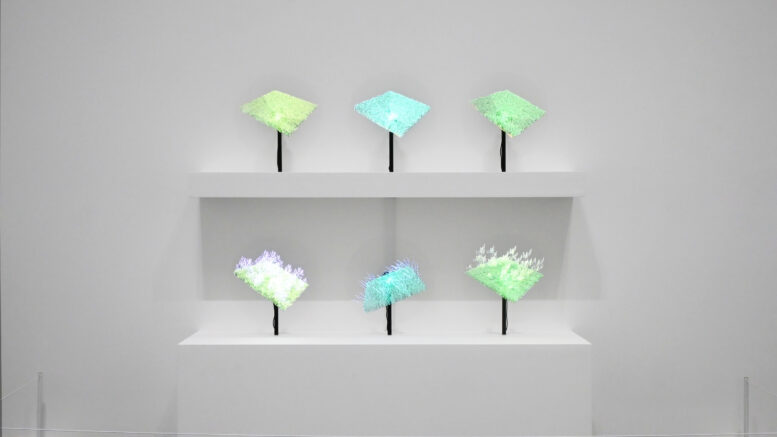
WAG-Qaumajuq’s recent exhibition is the touring exhibition we tend to care by multidisciplinary artist, mother and community organizer Carrie Allison, which opened on Feb. 6.
The exhibition, produced in collaboration with Urban Shaman Contemporary Art, is displayed in two locations in Winnipeg — the Urban Shaman Gallery, curated by Franchesca Hebert-Spence (Anishinaabe, from Sagkeeng First Nation), and at the WAG-Qaumajuq, primarily curated by Marie-Anne Redhead (Ininiw, from Fox Lake Cree Nation, and French Canadian).
Allison (nêhiýaw/Métis/mixed European descent) is based in Halifax, Nova Scotia, with maternal roots in High Prairie, Alberta. According to an artist statement on her website, her art practice responds to her maternal nêhiýaw/Cree and Métis ancestry and thinks through themes of intergenerational cultural loss and “acts of reclaiming, resilience, resistance and activism.” She also explores notions of allyship and kinship.
“[Allison] is a very thoughtful maker and really sits with an idea for a really long time,” said Hebert-Spence. “This exhibition has been brewing since 2016 […] She’s really irreverent about these spaces, and I think it adds to her criticality around thinking about these day-to-day processes.”
we tend to care centres around themes of property and public space. The exhibition encourages visitors to think about everyday rituals related to the land, such as lawn mowing and maintaining spaces to “fit a status quo” that has caused historical harm. Allison goes against these notions, treating plants as kin, like equals or family members.
Hebert-Spence explained that Indigenous peoples in Manitoba have long been identified by settlers as “not using the land properly,” followed by the replacement of plant kin native to the region with grass and agriculture. This replacement has had long-lasting negative effects.
“Anyone who’s lived within an agricultural community [has seen] the difficulties that have arisen from soil deterioration and the implications of pesticides and things like that on our animal and plant kin,” Hebert-Spence stated.
There is some variation between the exhibition at Urban Shaman and the one at WAG-Qaumajuq. The exhibition at Urban Shaman has a greater focus on Allison’s multimedia works, including CGI holographic grass that can be projected onto a lawn, while the installation at WAG-Qaumajuq focuses primarily on “relationship building” and “gestures of care.”
“The show is really getting me to think so much about materials and what they embody and what they symbolize,” said Redhead.Additionally, the installation at WAG-Qaumajuq is an exhibition-within-an-exhibition, appearing within Collection on View: European and North American Art, 1500-1900. When planning the show, Hebert-Spence and Redhead thought it would be interesting to have it intervene with WAG-Qaumajuq’s permanent collection, and the themes of we tend to care tied into the time period of 1500 to 1900 in a fascinating way.
“During […] and towards the end of the Renaissance, there was this period of Enlightenment which developed ideas of property and property ownership,” Redhead explained. “So, tracing back that genealogy of European notions of what land is […] Carrie is speaking against the European notions of […] land as something that you own or dominate and subjugate.”
One of the curators’ personal favourite pieces by Allison is “Red River,” with Redhead saying that her appreciation for the piece is deepened by an appreciation for the namesake river. Hebert-Spence highlighted the 2022 performance art video “Our Hands, Our Body, Our Spirit” for its commentary on how Canadian land art and concrete interventions focus on “ego” and have not taken into consideration possible harms to the land.
“The exhibition is [called] we tend to care — we’re tending, we’re cultivating — because ultimately we want to be able to provide that care and to be reciprocal to the beings and the kin that support us,” she stated.
Carrie Allison’s we tend to care opened at WAG-Qaumajuq on Feb. 6. For more information, visit wag.ca. For more information on Carrie Allison, visit www.carrieallison.art.