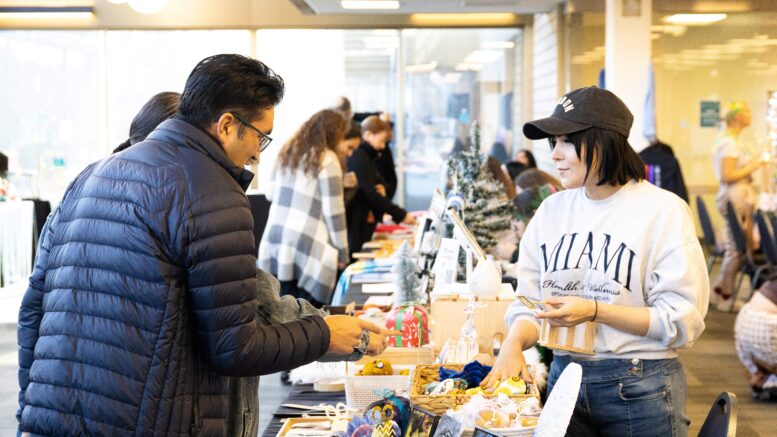
The Indigenous Winter Market returned to the U of M on Nov. 20 for its fourth year, bringing beadwork, ribbon skirts, paintings and handmade accessories created by Indigenous student artists to Marshall McLuhan Hall in UMSU Centre.
The event, organized through the office of the vice-president (Indigenous), was created to support Indigenous student vendors and build connections across the university.
Vanessa Lillie, U of M director of cultural integration (Indigenous) said the idea for the event emerged in response to increasing interest from faculties.
“When I was first in this role as the director of cultural integration, there [were] many faculties reaching out to find out who were the beaders and the painters and the students who were creating beautiful works of art at the U of M,” she said. “I created the Indigenous Winter Market in order to create space for connections.”
“Any U of M Indigenous student is eligible to be a vendor,” she added.
Lillie said the market has expanded significantly since its launch. The first two years were hosted in Migizii Agamik, but attendance quickly exceeded the building’s capacity. Last year’s market drew more than 500 attendees, and this year’s turnout appeared similar, according to Lillie.
“We were outgrowing all of the spaces that I had chosen to have it in,” she explained. “It’s great news to outgrow those spaces and to have so many people interested in the market.”
Lillie explained the market has become a space for community building. “It creates a space for people to come together and build stronger relationships across the university,” she said. “I really love the way that the market has brought people from all across our campuses to connect.”
Mariah Hanslip, a Métis beadwork artist, who sold handmade jewelry, stickers and pouches, said the market offers a meaningful way to share Indigenous art with the campus community.
“I just love being able to share Indigenous artwork with students on campus,” she said. “Whether it’s something that somebody is able to wear with pride or even if it’s just educating students that are coming by on Indigenous artwork, I think it’s really important to share that.”
Another vendor, Ethan Michlosky, has participated in the market every year. He has watched the event change, becoming bigger and better.
“It’s definitely changed for the better — it’s definitely bigger, more people [and] more variety of what people are selling,” he said.
Michlosky sold dot art, abstract paintings and prints. He said art first appealed to him because of how grounding it felt. “It always was therapeutic,” he said. “When I realized that I had a talent for it, I figured I would just pursue it further.”
He encouraged other students to participate in the market. “Just do it,” he said. “It’s giving you experience, and at the end of the day it will just be a great time.”
Savannah Moon, also participating for the fourth time, said she has watched the market shift from a small gathering in the Indigenous Student Centre into the largest it has ever been.
Moon sells beaded earrings, beaded eyelashes, jingle cone accessories, wristlets and ribbon clothing. She also encouraged students to join the event in future years.
“If you don’t like your work, that doesn’t matter, because someone out there is going to think it’s so beautiful,” Moon assured.
“Even if you only have four pairs of earrings to sell, that’s still money that you could be putting in your pocket.”
Lillie emphasized, “Indigenous students are incredible artists, and often they use their creations as an outlet from some of the stress from school, as cultural reclamation and to learn from each other.”