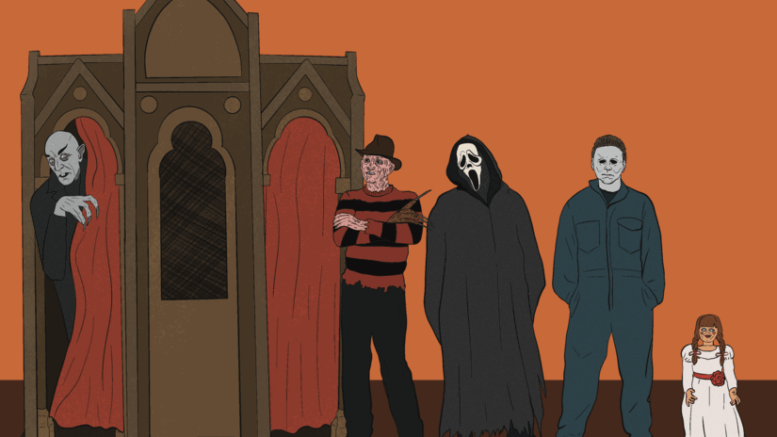
Stories — films especially — are hyperbolic extensions of the things we experience in everyday life. They enlarge the feelings we experience like love, fear, shame, desire and the incessant ring of mortality. Horror takes this exaggeration the farthest. With death, existential symbols and maybe a bit of gore, horror seems to have become the most honest genre as it confronts what we repress head-on, and offers us a playground of profound truths.
John Truby’s The Anatomy of Genres argues that each genre performs a specific function. Memoir and the coming-of-age story teach personal responsibility and the making of the self while fantasy explores the wish to be more than we are (which makes me think about how Marvel dominates big-budget productions). Horror, by contrast, fulfills the religious function in storytelling by confronting us with ultimate questions like those about death, and challenges how we should live if we want to pursue a good life that ensures a heavenly end.
In my opinion, the first biblical tale in Genesis is a horror story. When Adam and Eve eat the apple and learn they will die, a new acute awareness arrives, and with that comes the vertigo, the dizziness of choice. This disorienting experience lends to the insistence of questions like, “Who am I?” and “What should I do?”
Unlike genres that idealize human experience, horror strips away the familiar world and exposes the raw realities that people frequently ignore. I believe it forces audiences to confront uncomfortable truths which, as a result, require honest reflection.
John Carpenter’s Halloween was released in 1978, just before Oct. 31, and it reframed the suburban neighbourhood, which is regarded as generally safe, into a stage for pure terror. Michael Myers, also referred to as “The Shape,” does not run, speak, plan or explain himself. He simply is. He isn’t a villain with motives — he’s a masked void in coveralls, a walking subtraction of meaning. The movie’s point here is that in a rational, well-lit world, unexplainable evil can exist and even thrive. Yet Laurie Strode, the movie’s protagonist, responds to that void. She protects, plans and fights back. She makes meaning by resisting meaninglessness. Here, horror’s religious function is in full motion, asking the question, “When confronted with the inexplicable, will we act with intention and courage anyway?”
We find these symbols in all horror films. The Exorcist dramatizes a crisis of belief as faith requires doubt the way courage requires fear. Ari Aster’s Hereditary insists that we inherit more than heirlooms — we carry family trauma, mental illness and, perhaps, spiritual doom. The film uses the supernatural as a delicate frame for the metaphor of what bloodlines and traditions pass down through the family. In A Nightmare on Elm Street, Freddy Krueger is the burgeoning bubble of denial inside us that, if left unattended, results in unforeseeable consequences. The parents in the movie burn Freddy alive because he is suspected of killing children. In doing so, they evade justice, and their unconfessed violence returns in their children’s dreams. The villain in the movie is not just Freddy, it’s the lie the town has had to live with.
This is why the genre’s religious function matters. Horror asks us to look straight at death, then act as if goodness still matters. It exposes the reassurances we need to feel okay, such as, “The suburbs are safe,” “Science can explain everything” and “The past is over,” and replaces them with sturdier and, at times, exaggerated scares. But the truth is annealed around each horror story because evil can be senseless, reason can be limited and the past will resume until we face it. However, despite this, we as viewers (and the characters in horror films) can create meaning through responsibility, sacrifice, truth-telling and caring for others.
The idea of death results in the same response for us all. Fear is an emotion where the trigger is easy to define — a shadowy figure stands in the doorway, a deep, unbecoming voice crawls out of a child’s throat, a modified glove scrapes metal in a dream — while other emotions, like happiness, begin from a messier origin. We recognize danger together and react together.
Halloween is here. Sit in a crowded cinema and you’ll feel it — the synchronized intake of breath with the shared laugh after a scare. I believe that timing isn’t an accident — it’s emotional honesty revealing itself with rhythm. Horror aligns our heartbeats around inescapable truths we all know but tend to avoid. It tells us that the void is real, but so is defiance, so is love, so is the will to protect. If every story amplifies life, horror enlarges the parts we’d rather ignore, and in doing so, it shows us how to live. This Halloween, put a candy bowl out on your porch, get in your costume and go see a horror movie at the cinema.