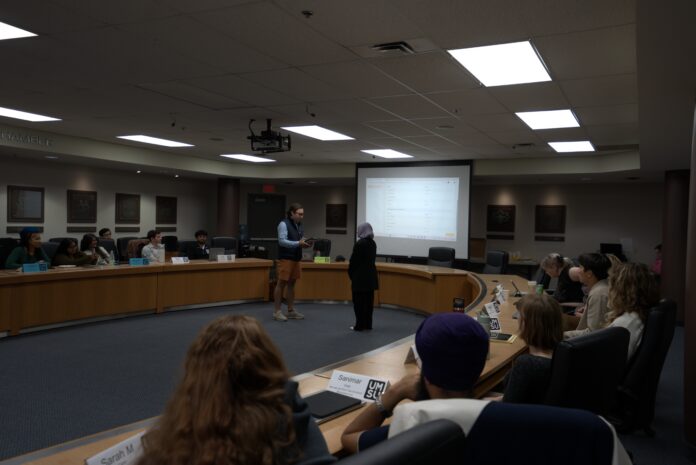
Indigenous graduate students gathered in the Elizabeth Dafoe Library on Oct. 23 for a day of quiet writing, shared meals and relationship building at the Supporting Aboriginal Graduate Enhancement (SAGE) writing retreat.
The retreat ran from 9 a.m. to 4 p.m. in the library’s Iceland Boardroom. It was primarily aimed at Indigenous master’s and PhD students and postdoctoral fellows, although non-Indigenous allies were also welcome to attend.
The retreat was organized by Don Davies, director for Indigenous research in the office of the vice-president (Indigenous) and Marsha Penner.
Davies said the goal was to have “a full gamut of resources” for students. Kookum Karen, grandmother-in-residence, was on hand to offer cultural support, and Antoanela Denchuk, an instructor with the Academic Learning Centre, provided writing support. Davies, who previously sat on a research ethics board, said many students have used the retreat to work on ethics applications, which allowed him to help them one-on-one and identify potential issues before submission.
Doors opened at 8:30 a.m. with coffee, tea and snacks. Davies said that the early stretch allowed attendees to connect before the opening proper at 9 a.m. where they discussed their programs of study and what they hoped to take away from the retreat.
The retreat followed a pomodoro-style structure, entailing an hour of focused writing followed by a 10-minute break to talk and recharge. The cycle repeated until noon, when the participants broke off for an hour-long catered lunch. Davies said past caterers have included Shelly’s Indigenous Bistro, an Indigenous-owned restaurant.
The afternoon followed the same pattern until 4 p.m.
“The lunch is really meant to be community building, peer building and you do see a lot of relationships form during this writing retreat, which is nice to see over the course of many months,” Davies explained.
Organizers hope to hold the retreat monthly, though no future dates have been scheduled yet.
Davies acknowledged that “Aboriginal” is an outdated term and said that he would like to update the program’s name. However, he noted that swapping in “Indigenous” doesn’t produce an acronym with the same ring, and that universities across Canada run their own SAGE programming without an updated name.
Davies said the program has become more visible since he arrived two years ago, thanks in part to the social media team promoting it.
Interested students who are also nervous about attending the retreat can access the drop-in sessions.
“It is a very welcoming space and people are on your side trying to help and you can be as social as you want or keep to yourself,” Davies encouraged.
“The writing retreats are fun because everybody else is writing and it motivates you and you don’t see people on their cell phones, and everybody has their heads down writing,” he added. “It is a very welcoming and inclusive environment.”
Davies explained that he still hears from past participants and has built meaningful relationships he has carried throughout his career. He said one of his regrets from his own graduate training was working mostly alone.
“I encourage people to come and just try it,” Davies said.
For interested students, upcoming SAGE events are listed on the U of M’s SAGE program page. Students are asked to register in advance to help organizers plan for food.