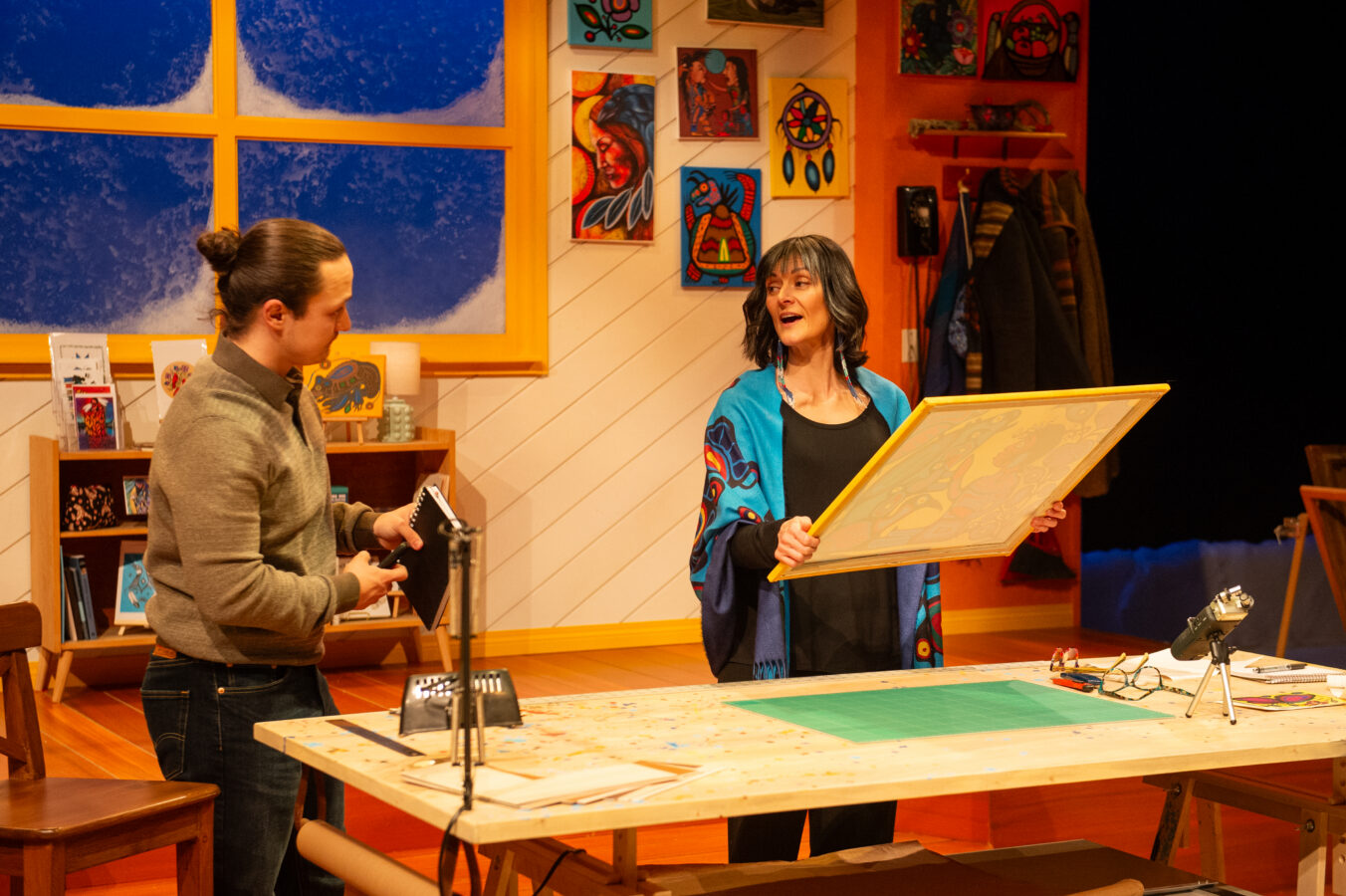
The Undeniable Accusations of Red Cadmium Light recently concluded its world premiere run at the Prairie Theatre Exchange. Ojibwe playwright Drew Hayden Taylor’s latest script is a character study of an expert on detecting fraudulent Norval Morrisseau paintings, over a series of conversations with her visiting daughter and questions from a journalist. In the process, the play raises greater questions about contemporary Indigeneity.
Morrisseau was an Ojibwe artist whose work is celebrated across Canada. He is notable for his role in the Indigenous Group of Seven and creating the vibrant and pictographic Woodland School style of Indigenous art. He is unfortunately also known for the large quantity of paintings falsely attributed to his name, which are the inspiration for Taylor’s latest play. Police investigated the phenomenon and found an underground network dedicated to the production and distribution of Morrisseau forgeries.
“I began to think of [fraud] dramatically,” Taylor described his creative process. “What if I used it as a stepping stone? As a larger metaphor for what was happening within the larger Indigenous community? […] I’m quite proud of the final product.”
The first act begins with a glimpse of Nazhi Nigig’s life, before Indigenous arts and culture reporter Martine Marten comes to her door. The reporter explains that he is there because he is writing a story about fraudulent Indigenous art and he has questions for her as an expert on Morrisseau.
Nazhi shows the reporter a painting and explains that it cannot be a real work of Morrisseau’s because the date does not correspond with the period when he was known to paint with the colour red cadmium light to depict skin. Nazhi states her opinions on the matter, that it is wrong for non-Indigenous people to exploit their culture for profit. She elaborates that she remembers when Indigeneity was something she had to hide, in contrast to nowadays as non-Indigenous people fabricate claims of identity. Martine soon shows a curiosity about Nazhi’s life, although she seems more interested in discussing her late husband’s art and his connections to the Indigenous Group of Seven. Days later, the journalist returns to reveal what he has uncovered from his research — Nazhi has no record of Indigenous ancestry, and “Nazhi Nigig” was not her name until adulthood.
“As it progresses onward, the focus and the shift of the story changes substantially into a larger exploration of authenticity and where we all fit on that scale of authenticity as artists, as people, as Indigenous people, et cetera,” Taylor explained.
The true conflict of the play comes through Nazhi’s conversations with her daughter, Beverly. They disagree on matters of what Indigeneity means and the role of Indigenous culture in the lives of individuals raised outside of it. There is discussion around the validity of culture or of legal status as a working definition. Moreover, greater emphasis is interestingly placed on debating the factor of a person’s upbringing, rather than the factor of ancestry.
Taylor wrote the play to be an opportunity for spectators to ask themselves where they stand on the topics presented. Rather than clear answers, the audience is left with an open-ended inquiry into the scope of personal identity, questioning at what degree individuals are deceiving themselves and others.
“Hopefully people sit down, scratch their head and ponder questions and statements made within the context of the play, and come away either with answers or better questions,” Taylor said.
A particularly strong moment is the final line, when Nazhi looks in the mirror and assures herself, “I know a fake when I see one.”
“I don’t even say either way what the truth is,” Taylor explained. “I’ve left it up to the audience to play around with the truth, but that final line, I think, points the audience in the right direction.”
This is not Taylor’s first time publicly tackling the topic of false claims of Indigeneity — CBC also aired his documentary The Pretendians in 2022.