The MHC Gallery at the Canadian Mennonite University (CMU) opened their latest show on Jan. 9, The Land Remembers Palestine: Courage, Resilience, Resistance. Upon entry, visitors are met with a recreation of a military checkpoint. Once they are passed through, the show is divided into zones: Palestinian history before and after Zionist attacks in 1948, 38 Palestinian artists, two memorials to artists and children killed by Zionist forces and art created by local activists.
The show’s lead curator is Rana Abdulla, who is also the co-owner of Yafa Café. Many of the antiques displayed in the historical sections are personal belongings from her family, brought from Palestine, including the collection of tatreez dresses.
“This is a collection by my late mother,” Abdulla told. “She thought after the 1967 war and the death of [Egyptian president Gamal Abdel Nasser], ‘There’s no way that somebody is going to defend Palestine as it is, so I have to start collecting this because our identity is threatened by erasure’ […] And when I came to Canada in the late ’80s, she said, ‘You take them with you,’ and she joined me after the Gulf War with my dad and we continued this work. And those are fabrics that bear witness and memory.”
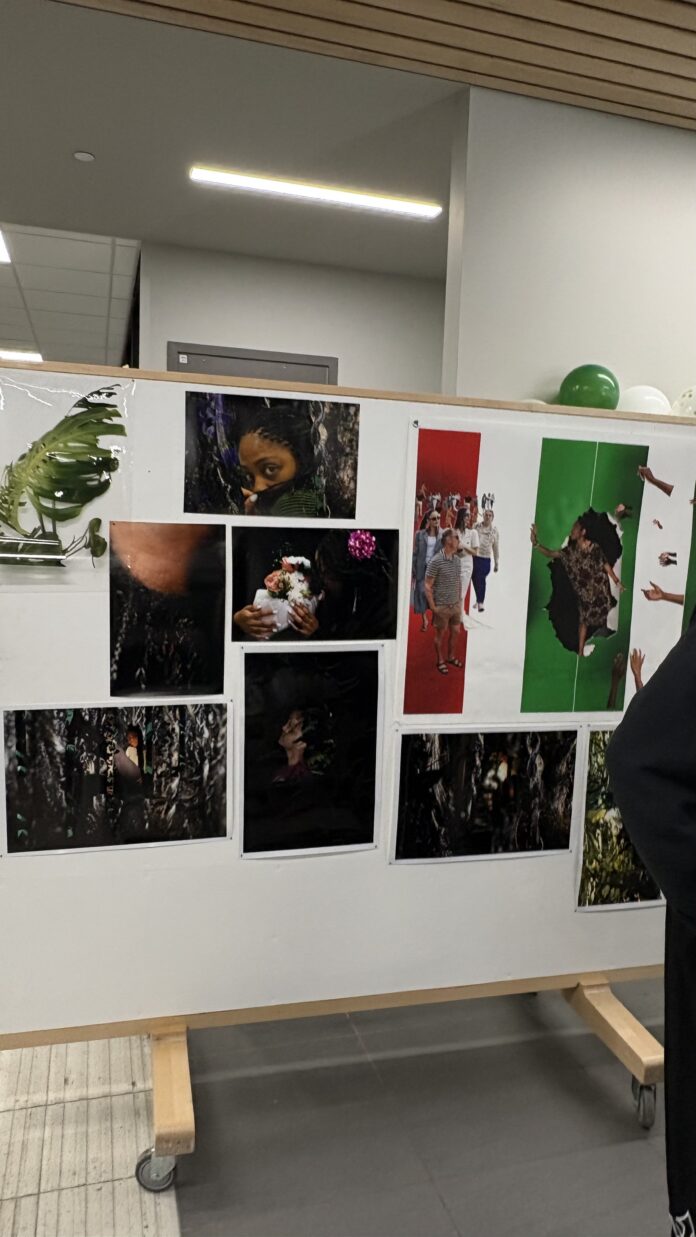
One of the featured Palestinian artists is U of M fine art student Bisan Dasuki. A display case showcases four of her conceptual works, two of which — “Box of Palestine” and “Massacre Blooms” — were also featured in the U of M student gallery last October. Dasuki created each piece as part of her coursework at the university. While some classmates had passive-aggressive responses, most were positive.
The largest work, “Box of Palestine,” is a wooden box in the shape of Palestine, depicting a pre-1948 map of major cities with their names in both Arabic and English. A watermelon is also painted on the lid because the colours of the fruit represent the Palestinian flag. Another artwork, “Massacre Blooms,” is a jar filled with poppies, which are native to Palestine. The red and white poppies are placed in rings, depicting a target, with a red handprint pressed onto the jar. It was inspired by the Flour Massacre in Gaza where Zionist forces injured 760 individuals on Feb. 29, 2024 as they attempted to collect flour.
Dasuki’s third sculpture, “Inventory of a Genocide (Gaza),” depicts an ice cream truck. It calls attention to their use in Gaza for storing corpses after the mortuary fridges were full.
“It was very disturbing to see an ice cream truck that’s supposed to be for kids […] carrying bodies. It stuck with me, and that’s why I wanted to make art about it,” Dasuki recalled.
Finally, “Kufiyah” is an image of the back of a person wearing a keffiyeh, featuring explanations of the garment’s symbolism. Specifically, it has comparisons to fishnets, olive leaves and trade routes. Dasuki draws attention to these origins to disprove claims that the garment was created by Zionists.
The Land Remembers will remain in the MHC Gallery until Feb. 28.