Crypto levy to reduce Hydro
The Manitoba government intends to use taxes collected from cryptocurrency operations to lower household electricity bills by approximately $50 annually.
Finance minister Adrien Sala shared that the provincial government projects $20 million in revenue, although collections could fall if companies shut down or relocate. The proposed legislation would also bring the Workers Compensation Board’s financial results back into provincial budget reporting, prompting opposition concerns about transparency and legislative accountability.
World Indigenous Business Forum
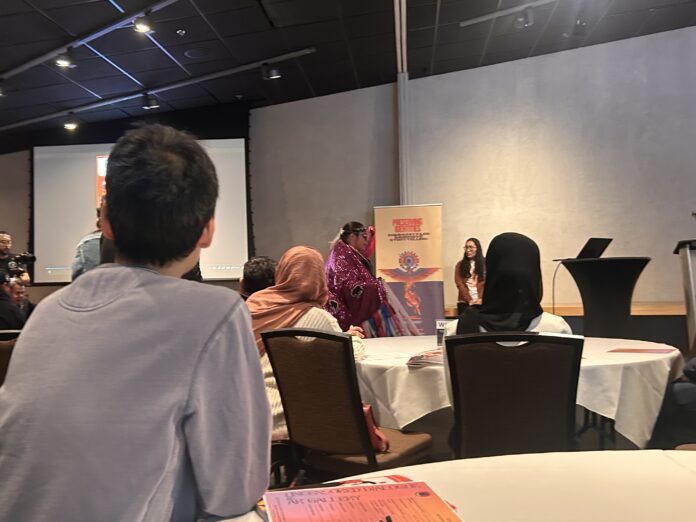
The World Indigenous Business Forum will host events and cultural experiences in Winnipeg from Oct. 26 to 30 alongside its official program. Activities include business-to-business matchmaking meetings at the RBC Convention Centre on Oct. 26, a welcome reception at the Canadian Museum for Human Rights and Neechie Nights, which precedes a gala on Oct. 27. Delegates can also attend the Tuesday Winnipeg Jets game and join guided Red River Métis cultural tours on Oct. 29 and 30. Some events require separate tickets or registration. For more details, visit wibf.ca/events-and-experiences/.
New regulations to e-scooters next year
Beginning in 2027, e-scooter riders and personal electric vehicles will have to follow new regulations under the Highway Traffic Act.
Some new rules include a 25 km/h maximum speed limit, 16 years as the eligible age for riders and mandatory helmets.
Also, personal electric vehicles will no longer be permitted on roads with speed limits more than 50 km/h or on sidewalks.
No more measles in the province
Manitoba health officials declared the provincial measles outbreak over on Oct. 16 after the last laboratory-confirmed case was identified in August. Since the outbreak began in 2025, Manitoba recorded 1,038 reported cases, including 52 hospitalizations and six intensive care unit admissions. No deaths were reported.
The public health officials encouraged Manitobans to ensure their measles vaccinations are up to date, recognize symptoms and follow public health guidance. Students can learn more about measles prevention and Manitoba’s routine immunization schedule at Manitoba Health.
OpenAI claims AI solved decades-old maths problem
OpenAI said its artificial intelligence (AI) system solved part of a decades-old mathematical problem involving fluid motion in 88 hours using approximately 10,000 AI agents.
The Navier-Stokes existence and smoothness problem concerns the mathematical equations governing fluid movement and turbulence. OpenAI said its system resolved two of the four statements required in the proof for the Millennium Prize problem, which carries a US$1 million award.
However, the proof has not been independently verified or accepted by the Clay Mathematics Institute, which administers the prize.
The announcement also prompted concerns from mathematicians Tristan Buckmaster of New York University and Levent Alpöge of Anthropic, who were independently working on the problem. Buckmaster alleged that information about their progress had reached OpenAI before the company began its work. OpenAI denied accessing their work and said the proofs differed significantly.
OpenAI reported that its AI agents exchanged nearly three million messages while working on the problem, using 130 billion output tokens. The company estimated the effort would have cost approximately US$10 million based on its pricing for advanced AI models.