I first saw Quintin Bart perform at a tribute show for the late John Prentice, a pillar in Winnipeg’s folk music scene, at the West End Cultural Centre.
I watched in amazement as he played guitar and double bass with what must have been four different bands, effortlessly switching from mellow indie songs to lively Irish jigs. Set after set, he walked on stage with his signature moustache and tied-back hair, and I thought, “Wow, that guy can play.”
His versatility is apparent, bowing soulful lines on his double bass with his folk trio Casati and drawing out rustic melodies from the hurdy-gurdy. At the same time, his virtuosic jazz solos never fail to elicit applause and hoots from the audience.
There is an understated, intimate expressiveness in Bart’s playing, one that can only be cultivated from a lifetime of playing. He is not exactly the kind of flashy, ebullient performer who will tear the stage up, but it is his thoughtfulness that shines.
Bart’s journey in music is a winding tale, spanning across continents and multiple genres before he coalesced into the musician he is today. Having grown up in a musical home with four older brothers, it seemed almost impossible for him not to pursue music.
“My mom plays accordion, dad plays guitar, and then eldest brother Lindsey plays guitar […] Next brother Nigel plays everything, banjo, saxophone, bass as well, electric bass. And then I have twin brothers who both play violin, and then myself, I was mostly playing bass as a kid,” said Bart.
“Ever since I was a little kid, live music together with the family was something that was there and so special.”
The family performed at events such as Canada’s National Ukrainian Festival in Dauphin and in senior homes. Bart is of Ukrainian, Polish and Doukhobor descent, and the family is steeped in both traditional Ukrainian music and Manitoban fiddle music. His grandparents were mostly farmers, but music was always there, especially in the evenings to unwind, connect and celebrate.
Bart went on to study at the U of M school of music and earned a degree in double bass jazz performance in 2009. He studied under the late Richard Burleson, a professor in ethnomusicology and early music who encouraged him to pursue his interests in Romani music.
In the following year, Bart moved to Budapest, Hungary, playing traditional Romani music with a local family band and working with the anti-Roma discrimination NGO Phiren Amenca. He noted that the music and human rights issues were closely intertwined.
“It was [about] inviting Roma and non-Roma people to get together and converse and discuss and learn ways to challenge the systemic racism,” he described the organization.
According to the European Parliament, the Roma face significant discrimination in the EU, with many experiencing poverty, harassment and poor living standards.
“I’m not Roma myself but inspired by Roma music. I also feel very much like it’s my duty to shed light on the human rights issues and try to create some positive social change,” the musician added. He continues to connect with Romani communities in Canada and volunteers with advocacy groups such as the Canadian Romani Alliance.
Bart plays jazz manouche, a style of jazz pioneered by Romani guitarist Jean “Django” Reinhardt (1910-1953). Reinhardt blended jazz with his folk traditions and bals musette (French dance music), said Bart.
“I’ve always found him so inspiring,” he said. “There [are] thousands of recordings of him, and he rarely repeats himself. Always the improvisations are fresh and spontaneous and very honest. You can tell that he really means what he’s playing.”
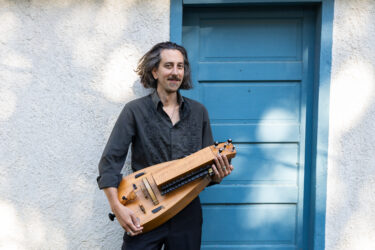
Hungary has not only given the musician new experiences, but a new instrument too. He found a hurdy-gurdy in a music shop and brought it back to Canada, teaching himself how to play it using the internet.
To play the hurdy-gurdy, the musician turns a wheel using a crank with their right hand, which rubs against the instrument’s strings. The left hand frets the strings using wooden keys to create different pitches.
“When you’re playing it and you have the drones going, it’s creating this constant kind of resonance. The wheel spins. This is like the never-ending bow,” Bart explained, describing the instrument as a mechanical violin.
One special feature of the hurdy-gurdy is the trompette string, which passes through a bridge (the chien) that hammers against the soundboard causing a distinctive buzzing sound when the wheel is turned quickly. “The mechanics of it take a lot to figure out because it’s like a wooden machine. If the humidity changes [or] temperature changes, it doesn’t want to play, so [there was] a lot of a learning curve on that,” Bart commented.
According to Bart, the instrument dates back a thousand years to medieval Europe, and it was originally used in churches before spreading to commoners and royalty alike by the 18th century. It is still used today in genres such as avant-garde, metal, jazz and rock music.
“We don’t see [the hurdy-gurdy] that often, and yet there’s something oddly familiar about it, I think. It can sound like bagpipes, or like accordion, or violin or things we know, but a little bit different and ancient sounding.”
The hurdy-gurdy brought Bart across the Atlantic once again to study with renowned teachers in Austria, Switzerland and the U.K., this time with funding from the Manitoba Arts Council. Bart also teaches students hurdy-gurdy.
He later composed a series of chamber music with the hurdy-gurdy at the centre, called The Oroboro Vignettes. Its title draws parallel between the symbol of the tail-eating snake representing continuity and the uninterrupted droning of the medieval instrument. Bart received a grant from the Manitoba Arts Council supporting the project in 2018, and it is set to premier at the St. Norbert Arts Centre on Sept. 20.
“[The vignettes] are often very short little snippets, more akin to Erik Satie’s Gymnopédies or these short little sweet things that just, for a moment, take you somewhere,” Bart described.
“It’s a long process, but I’m so happy. It’s a dream come true, really, to be able to share this music.”
He added that The Oroboro Vignettes blends his Slavic roots with the traditions and heritage of the six other performers, who come from backgrounds such as jazz, Afro-Cuban and Moroccan percussion.
“[We are] creating something new, which is sort of what Manitoba is about. It’s all different people together, and we can really create something beautiful together,” he stated.
Community and connection are at the heart of Bart’s music. He recounted how during his time in Hungary, he felt a connection with the family band through performing together, even if he could not speak Hungarian or Romani well.
For Bart, performing is about creating a reciprocal relationship, and it has become a vital part of his life.
“Music performance is like a sharing of the state of the performer with the listener,” he said. “We put this energy out as a performer, and the listener somehow feeds this energy back to us, and you create this loop of energy that really creates a sense of community and healing.”
“During the pandemic, it was very difficult as a performer. I really realized that I need performing in my life to feel good and to feel like that’s my way to contribute to a better world in a subtle way.”
In the face of fearmongering, war and an increasingly divided society, Bart has found connection through music to be the antidote, especially in an outdoor concert like The Oroboro Vignettes.
“I’m hoping that my notes and my compositions will frame the silence or the natural sounds, in a way that brings people into the present moment and feeling really grounded in the natural space, feeling respect and honouring the natural space that we live in, and connecting with one another with compassion,” he said.
“That’s my main goal of why I do music.”
Visit quintinbart.com for tickets to The Oroboro Vignettes and future performances.