The woman sits, her glassy eyes staring aimlessly into the distance while shifting apparitions of faces and arms float around her. Her hands, clenched tightly into fists, grip and pull strips of paper across her chest. It is as if she, too, like the paper, is about to snap at any moment.
Titled “Pull/Tension,” this portrait is one of Lisa Wood’s seven oil and coloured pencil paintings in SHIFT/WORK: Portraits of Precarity, a SSHRC-funded cross-disciplinary exhibition at the School of Art Gallery that explores the embodied experience of unstable employment in rural Manitoba.
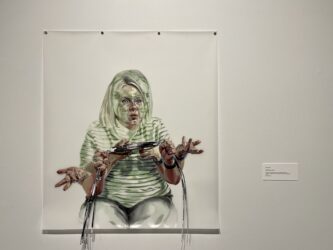
“Pull/Tension” by Lisa Wood. Boris Tsun Hang Leung / The Manitoban
A U of M and Yale University fine arts alumna, Wood is a visual artist and associate professor of fine arts at Brandon University. Her artistic practice can be described as figurative, focusing on portraits, gestures and how people hold their bodies. Credited to her upbringing with a single mother and her experience with chronic health conditions in rural Manitoba, Wood’s work subverts traditional portraiture and depicts those often neglected in the genre — the non-aristocratic and the unwealthy.
SHIFT/WORK is the culmination of research by counselling psychologist Breanna Lawrence and rural health geographer Rachel Herron, along with artwork by Wood and contributing artists Renata Truelove, Michael Vachon and Dhairya Vaidya. According to Wood, its title derives from a play on words — working shifts, and shifting lives as Manitobans navigate migration, rural living, mental health and family life.
In 2024, the team recruited participants experiencing precarious labour in rural Manitoba. Precarious labour is described as work that is unstable, underpaid and lacking in benefits, a phenomenon exacerbated by the COVID-19 pandemic. Precarious jobs may be short-term and contract-based and in settings such as meat packing plants and casinos, but it can take many forms in the gig economy, Wood noted.
Moreover, employment and the cost of living have been major sources of concern among Canadians in recent years, a sentiment well reflected among the participants.
“Not only are you working, but you’re also thinking about how you can get more work, or if you’re going to have enough money to pay the bills that month. And so you’re not just stressed about work. You’re stressed about the concept of work, or the ramifications of not having enough [work],” said Wood.
Some of the recruits were newcomers who wanted to start a new life, but they were often greeted with barriers and red tape. At the same time, international migration to Manitoba reached an all-time high immediately following the pandemic, and the province received 23,589 immigrants and 35,047 non-permanent residents in 2023-24, according to Statistics Canada.
“What we found in rural Manitoba is there are a lot of newcomers […] They have a lot of very specific things going on for them, involving retraining or having their certifications from elsewhere recognized here in Canada. And so a lot of them are doing survival work,” Wood commented.
For two weeks, research participants were prompted to take photographs and write reflections throughout the day, which became qualitative data for the contributing artists to analyze and turn into art.
Vachon combined crisp pencil drawings of office life, obscured faces, written text and more to create busy, non sequitur and almost surreal collages. Here, the viewer looks through the eyes of the precariously employed. Precarious work is chaotic — it is everything, all at once.
A piece by Truelove depicts a man with children on either side of his shoulder, literally shouldering the responsibility of providing for his family. However, despite dominant themes of uncertainty and anxiety, the workers’ lives are juxtaposed by stoicism and resilience, with sketches of loved ones and tenderly held hands.
In the second phase, the participants were interviewed on video to tell their stories. The team coded gestures and facial expressions in the footage, and Wood selected stills to use as references.
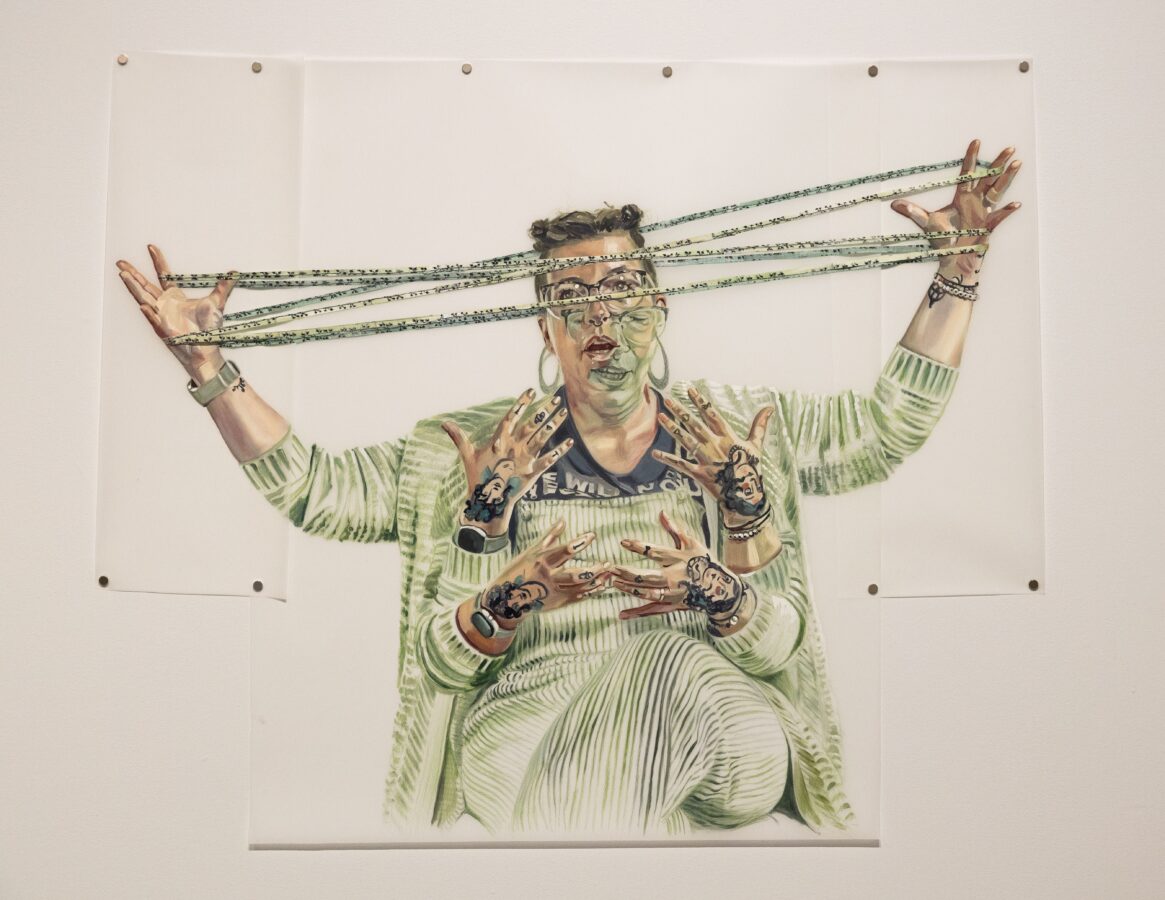
The portraits were painted with bold brushstrokes, using desaturated shades of greens and skin tones against white backgrounds. Hands are an integral motif in Wood’s artwork. Each portrait possesses several arms, and each hand seems to convey its own message, almost evocative of the thousand-armed bodhisattva and mudras (hand gestures) in Buddhist art. Reproductions of the contributing artists’ works were shredded, woven or knotted and incorporated as sculptural elements in the paintings to show symbolically and literally, how precarity has disassembled and restructured people’s lives.
Wood’s biggest piece, “Up in the Air (Hold Back/Throw Off),” is a triptych based on snapshots from a Zoom interview with a participant, hence the unconventional angle. She reaches her hands to catch strands of paper falling from a net suspended above her, but they escape her fingertips and fall to the ground, her expression frustrated and desperate.
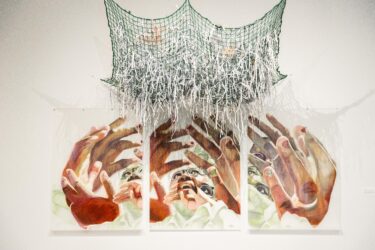
“Up in the Air” by Lisa Wood. Ebunoluwa Akinbo / The Manitoban.
“[She had] her hands in front of her face a lot of the time, and she was really expressive in this way. And there was a sense of being fed up, but also a sense of letting go,” said Wood.
“[I was] thinking about all of the things that might be held at the same time in the net. And then the net, it’s working most of the time, but things are still slipping through the net […] I thought that that metaphor really spoke to that participant.”
Apart from visual art, Wood and audio artist Brendon Ehinger created a collage using audio recordings of the participants. Overlapping and interwoven voices of various accents are played on two speakers, recounting stories as fragmented as their lives.
Participants may be putting themselves at risk by sharing details of their precarious work, but the process was guided by ethical procedures. The identities of the individuals are deliberately kept secret, and the portraits are shown in regions where the portraits’ subjects are less likely to be recognized by visitors.
“This was the most pressing issue of the work […] You want to be able to honour them and do right by them as they’re choosing to be in the project, and you also want to be able to tell their story truthfully, but you need to make sure that you’re not revealing too much information,” Wood stated.
Despite the anonymity, Wood hopes that people can see themselves in the art or empathize with those who live in precarity.
“It’s also important to think about how feeling value from work is essential for people to have the resources in order to live a good life, but also to feel that you’re contributing and that you are a part of society in a meaningful way,” Wood added.
Perhaps one day, we will emerge from workplace alienation into an era of fulfilling labour.
SHIFT/WORK: Portraits of Precarity will be on display at the School of Art Gallery until May 1. For more information, visit umanitoba.ca/art/shiftwork.