The School of Art Student Gallery’s previous exhibition, titled reCLAYm, recently concluded on March 11. Curated by final-year fine arts student Madeleine Alsip, reCLAYm showcased pieces by U of M ceramics students created in the Art Barn to celebrate the diversity of works that can be made with the medium.
“[The Art Barn] is the ceramics and sculpture building, and so that is the only place where ceramics students can make their work […] We’re kind of detached from the primary ARTLab,” Alsip said.
The Art Barn may be detached, but there is a thriving and tight-knit ceramics program at the U of M, according to Alsip, hence the desire to reclaim and take up space in the ARTLab. reCLAYm featured works by Alsip and 13 other students. One of pieces is Alsip’s “matter & mattress,” which shows a figure levitating above a bed with a colour scheme reminiscent of blue and white pottery.
“It depicts a person or a figure, upside down, caught in a web of fabric attached to this mattress […] It’s up to the viewer to interpret whether they’re stuck within the mattress or trying to escape, if fabric’s holding them back or if they’re trying to break out of it,” the curator explained.
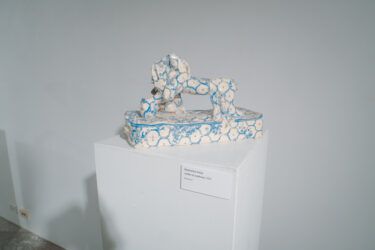
“matter and mattress” by Madeleine Alsip.
Emma Gillich, one of the featured artists and the Manitoban’s graphics editor, created “Mace me,” a spiky ceramic mace coated with a dark glaze. She commented that humour is an integral element of her piece.
“So much about what I’m doing in my honours year is so serious and just annoyingly high art. So I thought […] what’s more fun than making a funny weapon that people just want to pick up and wave around?” she said.
“I visited Germany as a child, and they had so much medieval weaponry there […] I’d always dreamed of making my own, so I decided now’s the best time [to] take that and just run with it, very much fulfilling my childhood dreams.”
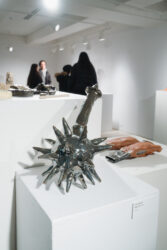
“Mace me” by Emma Gillich.
Another artist behind the exhibition is Michael Wood, a longtime ceramist who created “The Arcanum” to explore the relationship between geology and ceramics. He collected rocks from all over New Brunswick, crushed them into powder and applied them onto clay, giving it a glassy appearance.
“[I brought the] pieces together with a rock mounted to the wall. The rocks themselves [are] made into ceramics,” he said. “I’ve made copies of those [rocks] to think about the connection of deep time in relation to human time, and how ceramics is recreating the rocks […] on a shorter time scale.”
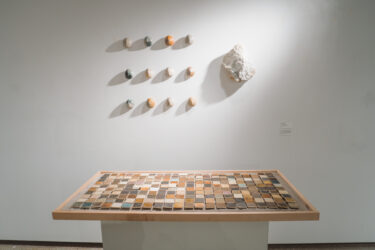
“The Arcanum” by Michael Wood.
Alsip noted this is the last show she will curate at the school of art, and it is one dear to her heart. She hoped that with reCLAYm, she has shown that ceramics is more than a craft medium and a versatile fine arts material.
Wood echoed the sentiment, highlighting how something as unassuming as clay has shaped not only art, but humanity as a whole.
“When we think about ceramics, we just think of functional things, and sometimes the sculpture or the building material or the construction aspect or the geology,” he stated. “[But] ceramics is so ingrained in our history, and it allowed us to […] start agriculture and to share information and to store things and to travel. It’s such an important part of our lives and our time.”
For future exhibits at the School of Art Student Gallery, visit umanitoba.ca/art/student-gallery.