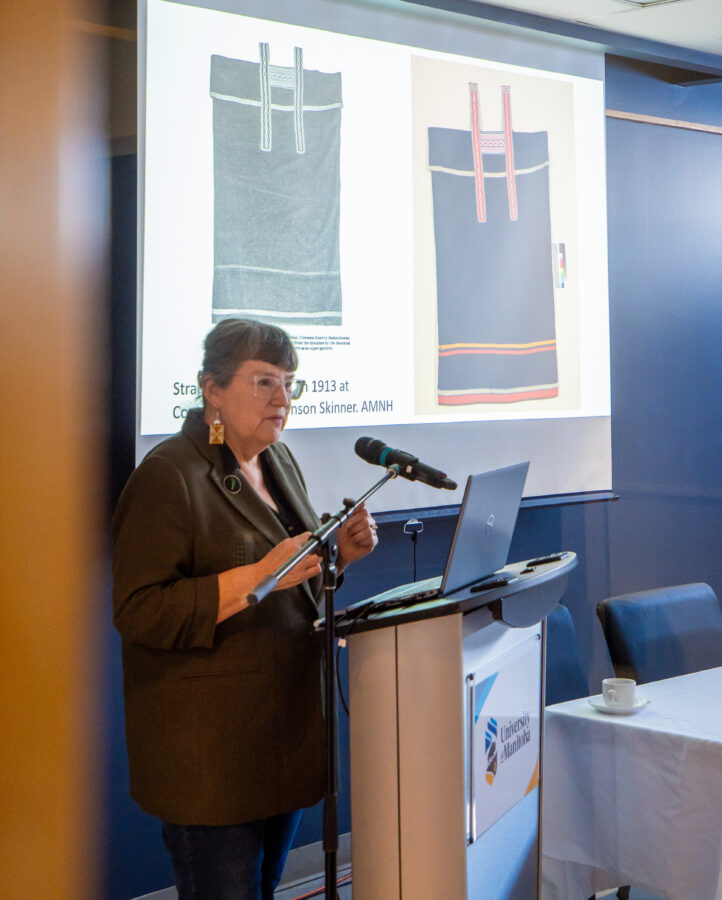
U of M students and faculty gathered in St. John’s College for the Centre for Human Rights Research event Stitching Histories: A Scholar-Artist In Archives And Museums on March 11 to hear Indigenous scholar Sherry Farrell Racette present her research on historic garments, especially those with limited provenance.
Racette has a particular interest in what she called a “grandfather” or “old man” — long hide coats predating the more well-known style of Métis jackets. Moreover, the coats bring light to lesser-known aspects of Manitoban Indigenous history and the wider fur trade. Such negligent records of Indigenous artefacts’ origins are very common in museums, according to Racette. She indicated she aims to facilitate repatriation.
“So much of the material that’s in museum collection is orphaned,” Racette explained. “It’s been completely disconnected from its source community. There’s no named artist [or culture], it’s just a lot of educated guessing.”
Racette talked about her research into a quillwork-adorned hide coat in Newcastle upon Tyne, England that belonged to a late-eighteenth-century Hudson’s Bay Company worker named Alfred Robinson. It was an unusual garment, comprising only two seams, and it uses the front legs of the animal as its sleeves. The artefact’s provenance detailed only that Robinson’s son donated it to another museum, who transferred it to Newcastle only 38 years ago. The label left behind from the previous museum dated it to 1786 and credited a woman’s name, but none of the Cree speakers Racette consulted were able to understand such an archaic form of their language.
Upon seeing Racette’s photos of the coat, an elder informed her it was most likely a cow hide. It was, at one point, more common to make garments from cows that nourished calves and grew larger bodies from it. Her research discovered that Robinson was a surgeon tasked with implementing health and care measures to reduce spreading of the 1780s smallpox epidemic in the York Factory settlement, south of Churchill. It was the first smallpox epidemic to reach the Hudson’s Bay trading post. The region also suffered a series of forest fires and declines in animal populations during Robinson’s time there. By his return to England, the record showed that he left behind a Cree wife and child, so his wife must have been the one to invest the time and care to make the intricate coat for him. And in that case, Racette noted that the peculiarity of its construction would have been a very innovative design as Cree clothing of the era only featured removeable sleeves.
“What I’m wanting to do is not so much curate an exhibition, but to facilitate […] a degree of community engagement that’s possibly, kind of unprecedented,” Racette shared.
Racette recalled a similar coat at the Smithsonian’s National Museum of the American Indian. One owner’s journal proved a line of ownership to 1851 in Saint Paul, Minnesota. Unexpectedly, the Smithsonian attributed its creation to Mohicans. But Racette found that Métis individuals of the Red River Settlement would bring carts full of items to sell or exchange for American products. At the border, they were charged a 20 per cent duty on buffalo hide robes and 30 per cent on moccasins, indicating that a prevalent market existed for those items.