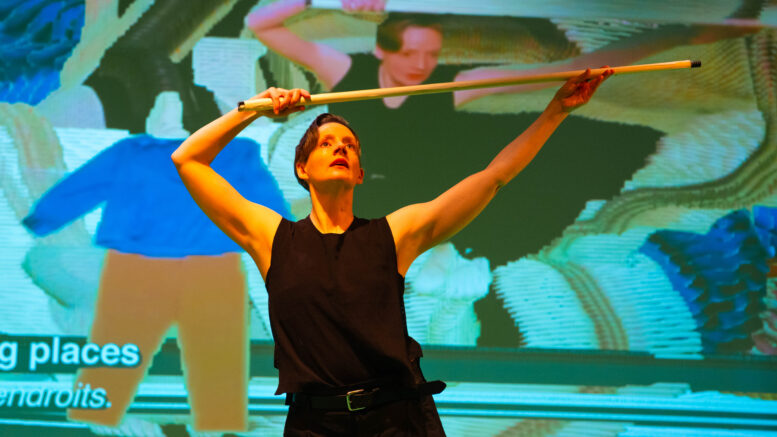
Cascading trails of arms, a twirling 3D model and ephemeral words that melt into digital noise — these are elements from the closing scene of Freya Björg Olafson’s MÆ – Motion Aftereffect, a live performance about the human body’s relationship with extended reality (XR) technology. The performance took place at Rachel Browne Theatre last week after touring Ottawa and Montreal.
In the final scene, Olafson gestures and spins on stage under a video camera while the footage is projected onto a screen behind her, coupled with a virtual model of herself.
“I used just a free phone app [called Photogrammetry] to make a 3D replica of myself […] and it gave me an avatar that I could animate with my own motion capture data. And then it’s played back live on stage through a software called Unity, which is used for building games,” Olafson explained.
The live footage of Olafson is made to have a ghosting effect, similar to how one gets a trail of mouse pointers when a computer crashes, creating hypnotic patterns and colours in real time.
Olafson is a Winnipeg-based intermedia artist and assistant professor at the U of M school of art with a focus on performance and digital media. She has been incorporating live video feeds and computers into her art since 2009, and pointed out that the everyday use of her computer has shaped her life.
“I wanted to bring some of my experiences engaging with popular media and technology and in the everyday, and comment on [or] explore how it is informing and shaping our experiences. So, in this piece […] there’s quite a bit of text that’s gathered from people online describing […] what they see in [virtual reality (VR)] or describing VR pornography experience, so that other people can decide whether that’s something they want to explore,” Olafson said. “I started this research [in 2017 to 2019, and people were] doing home motion capture tests using an Xbox Kinect, tools that were affordable for people to bring these techniques into their home, and that [was] quite an interesting, exciting time.”
There has been substantial interest in XR technology in recent years, as seen in the viral 2016 mobile game Pokémon GO, the rise of virtual YouTubers and Mark Zuckerberg’s infamous Metaverse. Olafson pointed out that while the XR boom is exciting, she hopes people will remain critical of the technology and aware of the challenges it could bring.
“Digital practice is not about necessarily the techniques or the tools that you use, it’s what you have to say with them. So I hope people are still excited and curious to engage critically with these tools,” she commented.
“[There are] lots of limitations and biases inherent in all tech development. So [I hope to see] more people involved and engaged at thinking critically and contributing to [help] shape what it is.”