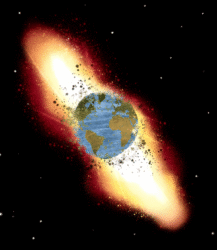
The Doomsday Clock is now 85 seconds to midnight, the closest it has ever been in its history. Created in 1947, the clock is set each year by the Bulletin of the Atomic Scientists’ Science and Security Board, signalling how close the Earth is to midnight, a metaphor for human annihilation.
Founded by Albert Einstein and J. Robert Oppenheimer, as well as a team of scientists at the University of Chicago who helped develop the first atomic weapons in the Manhattan Project, the Bulletin of the Atomic Scientists informs the public, policymakers and scientists on how to reduce human-caused threats to humanity.
In its 79-year history, the clock has been reset 27 times. Starting at seven minutes in 1947, the clock reached its furthest distance from midnight — 17 minutes — following the collapse of the Soviet Union in 1991 and the signing of the Strategic Arms Reduction Treaty (START) by U.S. president George H.W. Bush and Soviet President Mikhail Gorbachev. With the START treaty — which saw its end on Feb. 4th, 2026 — the two nations agreed to greatly reduce the number of strategic nuclear weapons they would deploy, mitigating the nuclear risks threatening human existence. As the treaty that safeguarded against nuclear catastrophe for the last three decades comes to an end, the world enters into an unprecedented era. For the first time since the early 1970s, there exists no legally enforceable limits on the nuclear arsenals of the U.S. and Russia. Currently, there are no discussions between the two countries regarding next steps, and officials on each side are left in the dark regarding the other nation’s intentions as well as nuclear capabilities. This uncertainty has left experts and officials warning of a potential nuclear arms race.
These concerns are not unfounded. In the last year, three nuclear powers have been involved in regional conflicts with catastrophic potentials. The war in Ukraine has introduced new and destabilizing military tactics, along with repeated Russian references to nuclear weapons. In May, fighting between India and Pakistan escalated into cross-border drone and missile strikes, raising fears of a wider conflict. In June, Israel and the U.S. carried out airstrikes on Iranian nuclear facilities believed to be linked to Tehran’s nuclear ambitions. It is still uncertain whether these attacks slowed Iran’s nuclear program or instead pushed it into greater secrecy.
These situations involving nuclear powers have all had an effect on the Doomsday Clock’s approach to midnight. Although initially created with nuclear risks in mind, the clock’s movement is also fueled by existing wars, detrimental advances in artificial intelligence (AI) and climate change.
An array of adverse trends has only reinforced this stark reality. The level of atmospheric carbon dioxide — the greenhouse gas most responsible for human-caused climate change, has reached a new high, rising to 150 per cent of pre-industrial levels. Global average temperatures in 2024 were the warmest in the 175-year record, with 2025 showing similar extremes.
Just last month, the United Nations University Institute for Water, Environment and Health announced that the world is no longer facing a water crisis but is rather water bankrupt. This era of water bankruptcy suggests that the world can no longer replenish water resources — rather, the water baselines have irreversibly shifted. Trends in the last year are all responsible for this change. Melting glaciers and thermal expansion pushed global sea levels to record highs, while an energized hydrologic cycle made weather patterns more erratic. Large swaths of Peru, the Amazon, southern Africa and northwest Africa experienced droughts, Europe saw more than 60,000 heat-related deaths for the third time in four years, and floods in the Congo River Basin and record rainfall in southeast Brazil displaced hundreds of thousands of people. Despite calls for more inclusive water governance, current approaches to AI development rarely account for the communities affected by the water use of data centres.
In its statement announcing the Doomsday Clock shift, the Science and Security Board issue a stark warning. “Our current trajectory is unsustainable. National leaders — particularly those in the United States, Russia, and China — must take the lead in finding a path away from the brink. Citizens must insist they do so.” If those in power fail to heed this warning, the clock will strike midnight sooner than we expect.