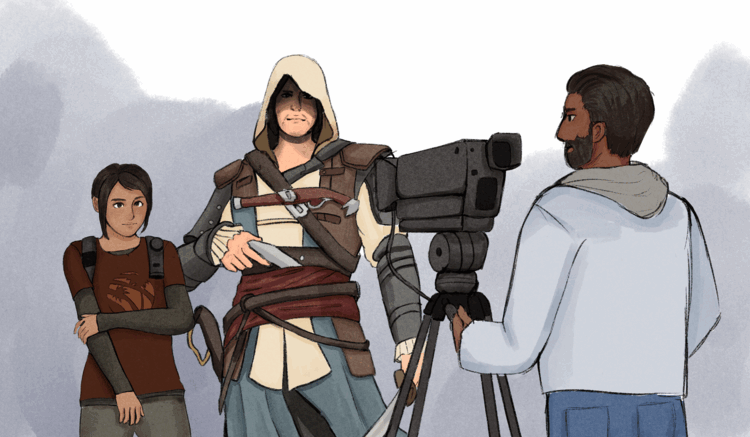
Before I ever picked up a camera or learned the language of film, I learned storytelling, framing and emotional resonance through a unique medium — video games. Growing up, video games weren’t just something I played, they were something I studied. Cutscenes, those crafted moments in which gameplay seamlessly blends with narratives, became my gateway into the world of visual storytelling. It shaped my understanding of visuals, character development and the power of a well-told story.
Video games are in a unique position in modern storytelling. Unlike films, they allow you to participate in the narrative, and the best ones always manage to deliver long-lasting emotions and unforgettable moments.
I have always been particularly selective about the games I choose to play. I look for titles where visual storytelling isn’t a side quest but the heartbeat of the game. Titles like The Last of Us, Assassin’s Creed and Uncharted became my teachers.
The Last of Us showed me how a single close-up, a shift in lighting and even a quiet pause can speak louder than dialogue. It also showed me how music can be blended with scenes to elevate a story. Every cutscene felt like a scene from a beautifully crafted film, focused and intentional. Particularly, whenever Ellie says something that reminds Joel of Sarah, his daughter that he lost just before the outbreak, there’s usually a moment of pause and a zoomed shot of Joel where he doesn’t say anything back, but his facial expressions combined with a brief glance at his broken wristwatch tell players that he was reminded of his daughter. It is from this game that I learned that cinematography isn’t just about what you show, it’s also about what you hold back.
Then there was Assassin’s Creed, an award-winning video game series developed by Ubisoft. This franchise consists of 13 main titles as well as multiple spin-off games, several short films and various transmedia projects. A masterclass in world-building and visual immersion, Assassin’s Creed has been widely known for creating worlds that consist of beautiful landscapes, ancient cities with towering structures and cutscenes that make history feel alive. This series taught me the importance of a wide-angle shot. It doesn’t just show a world — it sets the tone and the atmosphere of a story.
Uncharted taught me the importance of motion. Its cutscenes mainly consist of energy, binding story and action through dynamic camera movement. This series taught me how the camera can move the story, creating tension, rhythm and excitement without anyone saying a single word.
All these games have one thing in common — they respect visual storytelling. Visual storytelling is important to me because at a very young age I discovered that I was able to express myself better with imagery than with words, and these games use imagery to project emotions that resonated with me long after the credits rolled. The philosophy of visual narratives guides me every time I step behind a camera today. When I frame a shot or direct a scene, I carry the lessons from these games with me. The worlds that I explored on a screen helped me to create my own. These games didn’t just entertain me, they helped me find my voice as a visual storyteller and a videographer.