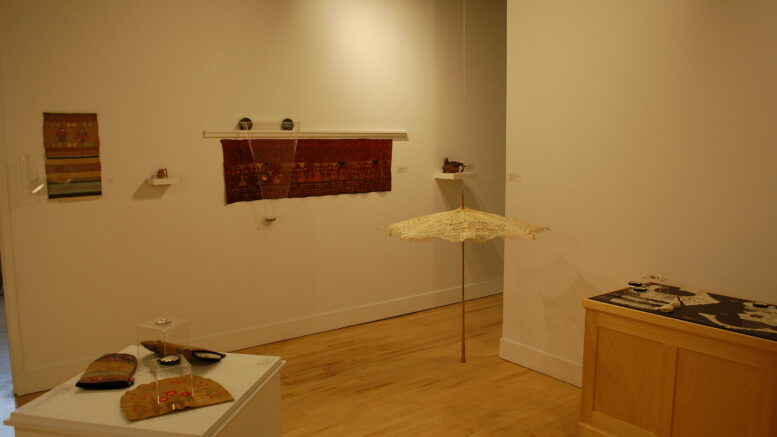
The C2 Centre for Craft’s Manitoba Crafts Museum and Library’s (MCML) latest show, Craft at Large, exhibits a selection of pieces from their permanent collection in an unconventional manner — magnification.
Each piece is paired with respective projector lenses, save for one microscope. Visitors are given magnifying glasses upon entry for their own exploration. These tools give the viewer a unique opportunity to learn by examining the detail of each piece. One can see each bead on a thread, every stitch in embroidery, netting patterns in lace and more.
Andrea Reichert, curator at MCML, had the idea of using projector lenses for a show. Dylan Stokes, a University of Winnipeg art history student, spent their summer internship surveying the museum’s collection to curate Craft at Large. They considered what could be learned from magnifying each piece while seeking to curate a variety of mediums, communities and techniques.
“Craft and art [do not] exist in a box,” Stokes said. “The mediums [or] contexts that we view them in change their meanings. They allow us to take a look closer or step back.”
Stokes sought to curate ethically by showcasing global craftsmanship. Visitors to the show will find items such as Inuit sculptures, Chinese silk embroidery and a Congolese cigarette holder. Many items in the museum’s collection came to Winnipeg via the tourist trade. Some recent acquisitions were also made by diaspora communities.
Crafts of Anishinaabe and Cree origin can be found as well. Notably, the show displays birch bark biting pieces by Cree artists Sally Milne and Angelique Merasty, as well as beaded mittens which are believed to be from the subarctic region, but the origins remain unknown. The mittens have often been showcased at the museum.
Showcasing prairie Indigenous art was a priority for Stokes. “For thousands of years, there’s been a long tradition of craft here,” Stokes told. “As an Anishinaabe curator myself, it felt important to me to add that personal nod to my own practice of making and beading and embroidery.”
Another prominent addition to the show is a lace parasol, which brings more fun and whimsical energy to Craft at Large. It is not new to the museum’s collection, but this is the first time it has been on display.
“[Parasols] really brighten up the space,” Stokes enthused. “I have a real soft spot in my heart for that parasol.”
There is power in embracing a more interactive model of exhibit curation. It is playful, creating accessible the means for visitors outside the fine art crowd to enjoy the show.
“I wanted people to feel like they could come up close to the pieces [and] take a look,” Stokes explained. “[I didn’t want the museum to be] a space where they should be quiet and mind their hands, but where they could pick up a magnifying glass and get a little closer […] and really spend their time playing and enjoying the pieces.”
“The public has been really receptive,” they reflected. “Everyone who’s come in has felt that accessibility in terms of, ‘Come and play, come and interact. This is a space for you.’”
Stokes elaborated that the inaccessibility of typical museum exhibits is a product of colonialism, and many Canadian institutions have been making efforts to change their practices since the UN Declaration on the Rights of Indigenous Peoples was passed.
“We need to [decolonize] and democratize and enliven these spaces that were so long presumed to be these religious, bureaucratic spaces,” Stokes voiced.
They have also taken a more relational approach to their work. Stokes described a sense of mutual care and reciprocity they have while stewarding the pieces in the show. They hope visitors will have experiences of personal exchange as well.
Craft at Large runs at the Manitoba Crafts Museum and Library until Dec. 18.