

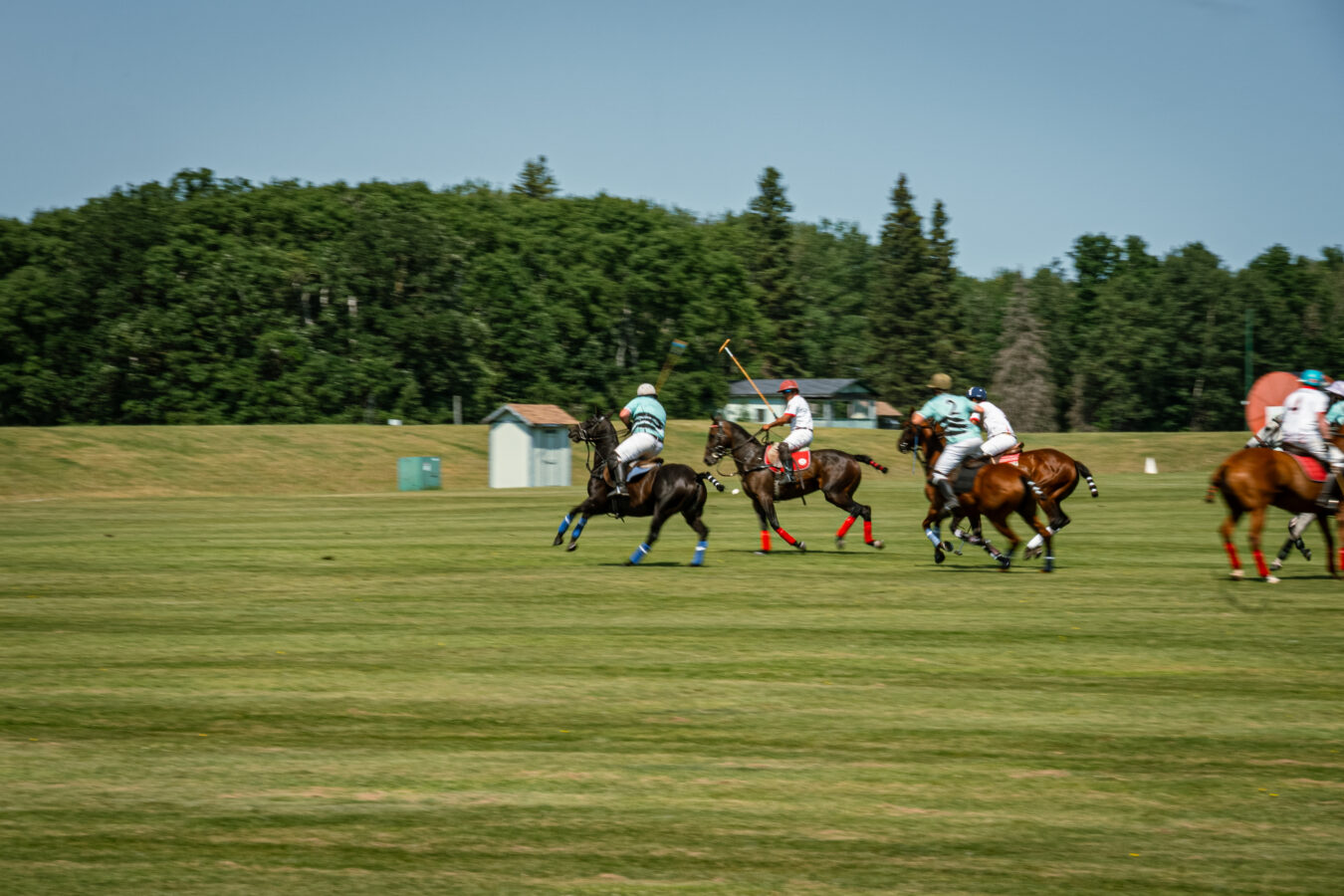
In scorching heat, horses graze across a field while players hunt a ball with mallets.
While sports such as padel and squash are taking the spotlight now for people to venture into, one sport has stood the test of time. With its rich, cross-continental cultural roots, polo has been played for centuries. With the snow gone, polo came to Manitoba.
From July 31 to Aug. 2, the Spencer Smith Memorial Tournament hosted its eighth edition this year at Birds Hill Provincial Park, bringing together local players alongside competitors from Alberta and professional players from Mexico.
The tournament was officiated by the United States Polo Association under umpire Robert Lyn-Kee-Chow.
For Flight A, Rocking S won the championship, with Regan Smith named MVP. For Flight B, team Alberta won the championship, with Chava Pina Reyes named MVP.
Team Manitoba opened the tournament with a blast. On July 31, Manitoba took the lead against Alberta in a three-game series. As it turned out, it was their only win. Alberta got back at Manitoba with a 6-5 victory. The series closed out on Aug. 2, when Alberta won 5-4 to claim the B Flight championship 2-1.
Manitoba’s lineup was Oscar and Sebastian Basaldua, alongside Jenna Trapp and Nial Carmichael, with Lauren King and Hope Keller rotating in the roster throughout the series.
The series did not end without any recognition for Manitoba. Carmichael was honoured with B Flight’s special award for playing above their rating, an indication of improvement in individual performance. Keller also held a roster spot on Rocking S, the eventual Flight A champions.
Smith, a U of M graduate, played for Rocking S. He described the tournament as welcoming and family oriented. He shared details about his practice schedule. “I’m here almost six days a week where we practice Tuesday, Thursday evenings at 6 p.m., and then teach lessons Wednesdays and Saturdays and play chukkers on Sundays,” he said.
Smith said his interest in polo came from his family’s connection to horses. “I grew up with horses, and my parents played, and so I started playing on little ponies,” he said. He has been riding since he was about five years old.
Smith added that there are about 15 U of M students involved with the club. He went into details about opportunities available for students. “We offer a lesson program […] where we teach classes on Wednesday evenings,” he said. “We do private lessons and group lessons where you actually get on the horse, learn the game, learn how to hit the ball.”
Smith said he is keen to spread the word about the sport. “What we try and encourage people to do is actually come out and see it in person, live, because a lot of people don’t know what actually is played here, even though it’s been here for quite a while,” he said.
Keller, a current U of M undergraduate, played for team Manitoba and team Alberta as a rotational player. She spoke about her passion for the sport. “I’ll be sitting at U of M library thinking about summer days at the club,” Keller said.
Unlike most other players, Keller is a first-generation polo player, but her parents did have horses. She expressed her initial disinterest in polo because she was a jumper, which she described as vastly different from playing polo. Her competitive nature eventually drew her to the sport. “I love the adrenaline from it and I love the intensity of the sport,” she said.
Keller also has seen the other side of the sport. At the previous year’s tournament, her horse went down and flipped over, causing the saddle to break and launching her onto the ground, where she broke her collarbone. Despite the injury, Keller’s interest in the sport did not waver. “Two weeks later I was back on the horse doing what I love,” she said. “Even though it hurt like hell, I just kept doing it.”
For Keller, that commitment says everything about why polo has stuck around. “I think that speaks a lot about a sport that you love so much, you almost die from it and you still want to play it,” she said.
Bruce King, a club veteran and a U of M law graduate, described the club as being made up of local amateur players, adding that they also bring in professionals from Mexico to help train the horses and play alongside them.
For King, polo is special because of the relationship between the rider and the horse. He added a key insight, that a lot of the club’s members are second-generation players. “It’s really a family club.”
King highlighted the tournament’s mix of professional and amateur players. Every player participating in the tournament is assigned a handicap, which is then combined to balance the teams. “Our tournament today is a four-goal tournament, so the combined handicaps over players should be no greater than four,” he said. “This is designed by the polo community so the professional players can play with amateurs. Professionals have a higher handicap, so there’s several players here that are two-goal players and […] you couldn’t have three two-goal players on your team because that would exceed the handicap.”
King emphasized the common concern that people have about the sport. “Some people think it’s dangerous because the horses are going 30 miles an hour, but we have very few injuries,” he said.
Despite the heat and potential injuries and collisions, it is the player’s desire to return to the field, captivated by the adrenaline and the relationship between the horse and the rider, that keeps the rider coming back for more.
