

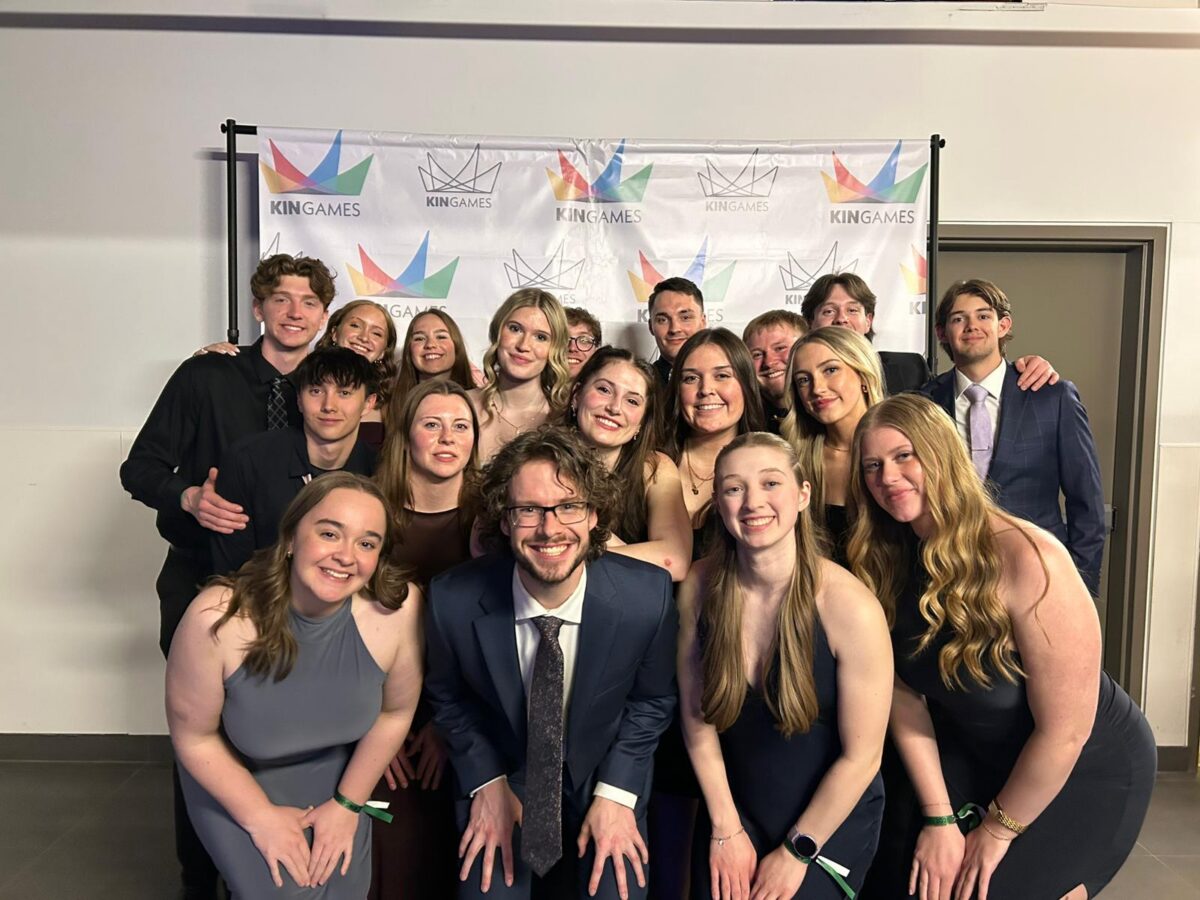
While most students were settling into the second half of the winter semester, a group of kinesiology students at the U of M were flying to Sudbury, Ontario to compete in Kin Games 2026 from March 28 to 22.
The Kin Games are said to be the largest undergraduate student kinesiology conference in Canada. This year, 25 universities showed up to compete across four pillars, including spirit, academics, athletics and dance over four days. At the end, one team walked away with the shoe, a trophy painted in the winning university’s colours. Jonathan Hiebert, Naomi Hudson and Abigail Mitchell-Lawson captained U of M’s team, Toba, through Kin Games 2026.
The team consisted of 16 to 18 kinesiology students drawn from all four programs in the faculty — kinesiology, athletic therapy, recreation management and physical education. Hudson explained that tryouts were held at the beginning of the school year, and from there, the team practiced once or twice a week all the way until the conference.
“We don’t charge for the trials at all,” Hudson said. “Anybody who wants to try out is more than welcome to come try out.” The cost comes in the form of conference and travelling fees. This year, with Kin Games being hosted in Sudbury, Mitchell-Lawson noted the total per-person cost climbed to roughly $1,600, out of which the $650 conference fee covered accommodations, some meals, the closing gala dinner and sponsor merchandise, while flights from Winnipeg ran close to $1,000.
Hudson noted that costs vary significantly depending on where the conference is hosted, taking into context the flights and a train ticket which came at a hefty price. She added, “that’s strictly because of the fact that Sudbury is a bit of a difficult place to get to.”
To offset costs, the team ran several fundraisers throughout the year. Mitchell-Lawson said their social event at VW’s, a bake sale, a climbing event at The Hive and individual pizza and cheese fundraisers allowed team members to raise money for themselves directly. Between all of it, Hudson confirmed that they raised approximately $4,100.
This year’s conference theme was The Great Outdoors, and the events reflected it. On the athletics side, teams competed in wheelchair basketball, Kho Kho (a traditional Indian tag-and-chase sport), flag football and a surprise Hunger Games-style free-for-all flag tag match. Kickball, originally planned as an outdoor event but cancelled due to weather, was replaced with dodgeball, while flag football and the pre-conference Team Ironman Challenge went ahead as planned.
Mitchell-Lawson highlighted wheelchair basketball as standout. “That was a really cool experience for us as kin students especially,” she said, “to put ourselves into that position and see what that’s like.”
Hiebert was equally taken by it. “I’m probably never [going to] play wheelchair basketball again,” he said. “It was great. It was fun.”
On the academic side, events included KinTank, similar to Shark Tank, where participants pitched research projects, a secret challenge called Cash Bus revealed only once teams boarded, a canoe portage relay where distance determined question difficulty and a 20-minute escape room set inside squash courts where teams solved a missing person’s case using kinesiology knowledge.
Spirit challenges ran throughout the year, including community acts of kindness and pen pal letters. Hudson explained that this year Toba was paired with the University of Ottawa. Team members exchanged postcards with photos and stickers in February, then got to meet their pen pals face-to-face at the conference. “It was nice to have that familiar face,” Hudson said.
Dance opened the conference at the opening ceremonies on day one. “Regardless of if you can dance or not, everyone puts 110 per cent in,” Hudson said. “And that’s all I can ask for from the team.”
Toba finished 14th out of 25 teams overall — eighth in dance, 14th in academics, 16th in spirit and 18th in athletics. “It’s not just about the outcome,” Mitchell-Lawson said. “We’re proud as captains for all the work that everyone put in.”
Hiebert put it plainly, “Kin Games in general more so focuses on fostering intrinsic motivation, just having fun and enjoyment rather than winning.”
Hudson pointed to something bigger. The team started this year with three brand-new captains and an almost entirely new roster. “I’m incredibly proud of everybody,” she said, “and just being able to still make that community within our team, these guys are going to be my friends forever.” Hudson compared the energy to a high school gym but at a university level. “We say at Kin Games, we’re all best friends,” she said. “You go around, you meet everybody, you make so many friends across Canada.”
For Hiebert, finding that energy was something he had been looking for since starting university. “I struggled to find people who are like me, who just enjoy playing sports, having fun, trying new things,” he said. “And then all of a sudden I found Kin Games, and I realize there’s a whole group of people who like to do that, and then you go to the conference and there’s 400 people who like to do that.”
Four days of minimal sleep have its side effects. Hiebert said one of the running jokes at every Kin Games is catching people asleep mid-event. “Everybody’s playing sports over here, and there’s someone fast asleep,” he said.
Mitchell-Lawson added that the kinesiology folks have a shared social media page where they post photos of teammates napping. “All of a sudden I see them over in the corner, they’re bringing the spirit,” she said. “It’s crazy how you can go from one personality to another all within an hour.”
Hudson described watching shy team members completely transform once they arrived at the conference. “Who are you and what have you done?” she said. “You have no choice but to feed into the energy because it’s all around you.”
The journey home was its own experience. “You leave and you get hit with the most severe case of tinnitus ever because you’ve just left your 500 new best friends,” Hudson said. The exhaustion is real too. “You’ve screamed for four days, you’ve gotten 10 hours of sleep over four days,” Hudson added.
Mitchell-Lawson put it simply as coming back to campus and seeing teammates bring it all back. “It just brings a smile to my face,” she said. “[Remembering] what we just did last week.”
Hudson summed up what the whole conference experience was. “The relationships that you make and the conversations that you have and the networking experience, that’s what really stands out. Not the ranking.”
Next year’s Kin Games will be held in Lethbridge, Alberta.
