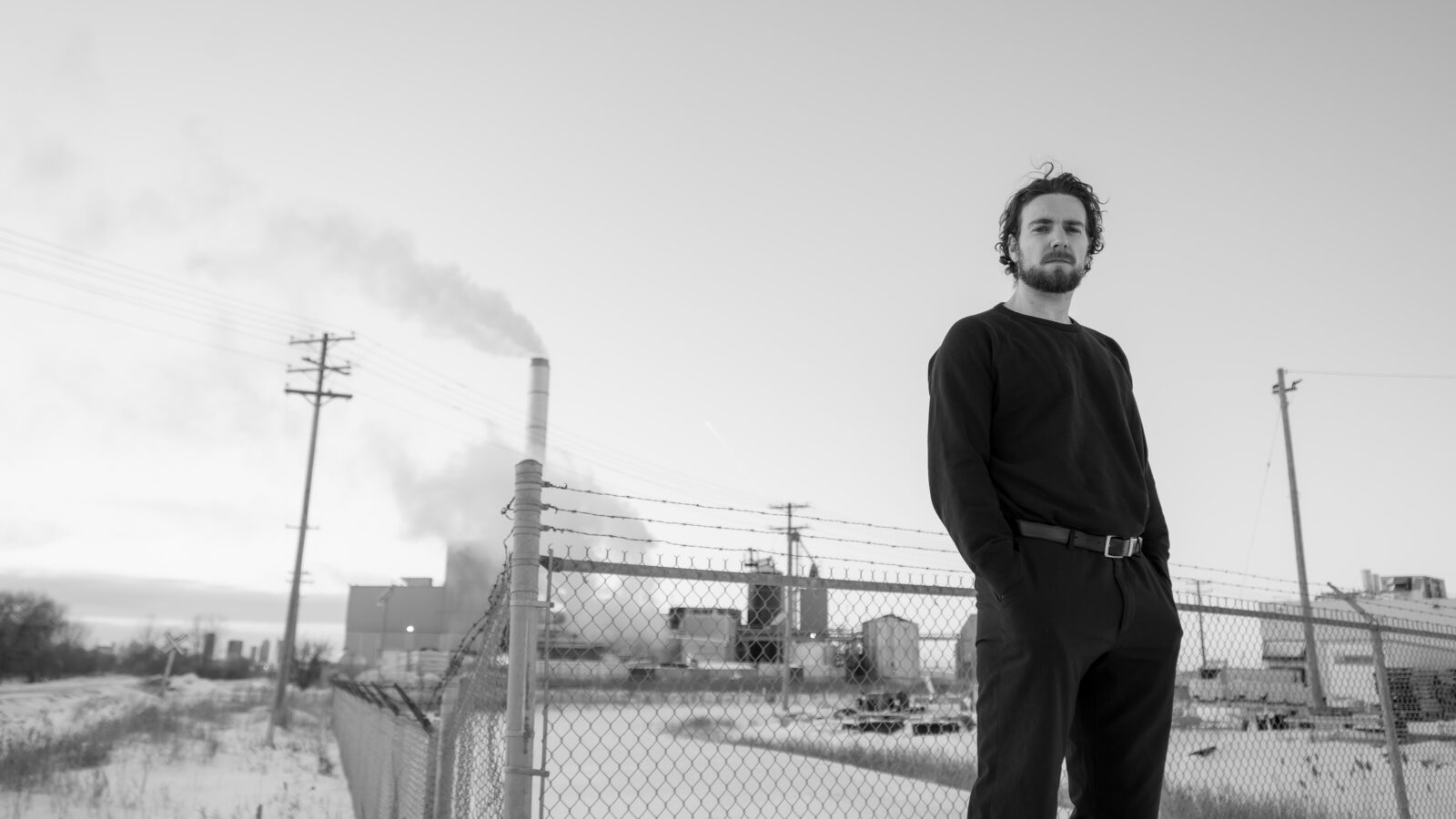
Local musician Tired Cossack released his latest album on March 26. The title, Zima, is the Ukrainian word for “winter,” matching the album’s cold Eastern European style of post-punk as well as the larger lyrical themes of debilitating loss and searches for existential meaning in the aftermath. Under his stage name, Stephen Levko Halas composed songs while undergoing chemotherapy after a cancer diagnosis in early 2024.
Halas remarked that starting the treatment would have been harder on him if he had known the full extent of the process. As the traumatic experience was prolonged, he began to lose his own sense of self.
“Everything in my life felt upside down and abnormal [and] poisoned in a lot of ways, because I was being poisoned, basically, very regularly. And it was physically and mentally destroying me, which is ironic because it’s the thing that saved my life,” he said.
The process was far from a straightforward path, and there were many periods of perceived progress only for symptoms to return. Despite everything, his intense focus on composition provided escapism.
“When everything else felt wrong or felt tainted, I could run into the arms of making music,” Halas recalled. “To just hyperfocus on making a song, or whatever it is, for four hours, and I would just forget where I was.”
“I’m piecing things together using music,” Halas described. “It’s kind of like this golden thread that connects [the] before and after […] I’ve been clinging to that quite hard, and so it’s like a reminder that I’m the same person, [and I] dictate [who] I am.”
Halas recorded an estimated 40 demos of his compositions on his laptop, when he could during weeks between medical interventions. After the second line of treatment, he began to recover. As he listens back to Zima now, Halas can feel compassion for himself as he struggles to return to his life before cancer and fulfill others’ expectations of his recovery.
The song “Dexsomnia” is one of the most vivid depictions of his experience. As the portmanteau suggests, the song describes Halas’s struggle to endure the insomnia caused by dexamethasone.
“[‘Dexsomnia’ is] very specific […] but I think that feeling is universal,” he related. “There are some things that are horrible that you just have [to] let go through you, because it’s going to happen anyway.”
The closing track, “Gran Turismo,” is an even more bleak representation of the fluorescent-lit treatment room. The lyrics contain an overt reference to a struggle with suicidal ideation. Halas was hesitant to include the line for fear of reaction from others in his personal life, but he ultimately decided it was better not to censor himself. Now that the song is out to the public, he hopes the honest portrayal of his mental state can provide comfort for potential listeners with similar experiences.
The presence of Ukrainian culture is another notable element of Tired Cossack’s music. Halas’s youth was spent surrounded by his Ukrainian heritage, so as a longtime fan of post-punk music, he was intrigued when he first heard the band Kino and discovered the genre’s prominence in Eastern Europe. Tired Cossack takes strong inspiration from them, and some songs are even sung in Ukrainian. The stage name itself was inspired by a motif of Ukrainian folk art.
Track two of Zima, “November 14,” also features vocalist Zagublena of the Kyiv-based post-punk band Sportcafé. Halas reached out to her as a fan to propose the collaboration.
“Something I’ve always wanted to do [is] celebrate being Ukrainian independently [of] ‘fundamentalized’ ideas around the Ukrainian identity in Canada. [Everybody knows] Folklorama, the dancing, the vyshyvankas (embroidered shirts), the food. And I’m not saying those are bad or anything, [but] I know all that. I don’t care about it anymore,” Halas explained.
“I want to think about [what] it means to me [now], and [what] contemporary Ukrainian culture means that is dictated by ourselves […] not dictated by anyone ‘fundamentalizing’ or saying what it should be.”