

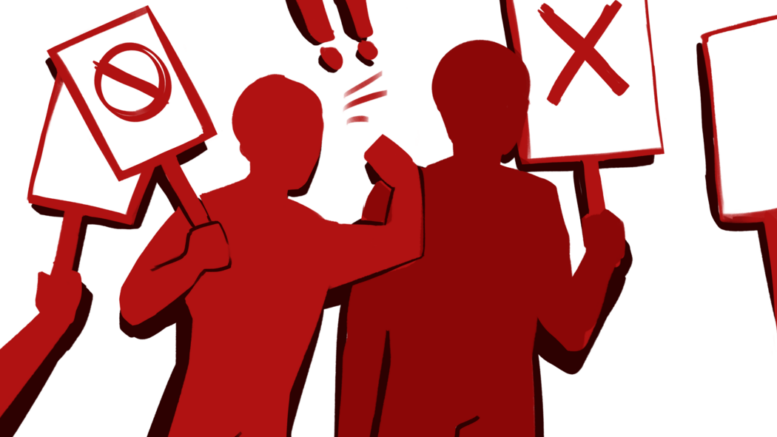
After a restrictive proposal to curb public protests, Winnipeg came together to shut it down. It’s a good thing we did.
On Feb. 10, the City of Winnipeg announced that the Safe Access to Vulnerable Infrastructure By-Law, put forward by Councillor Evan Duncan (Charleswood-Tuxedo-Westwood) earlier in 2025, had been drafted and would be brought before council on Feb. 17, 2026. The by-law proposed restricting protests through the use of 100-metre “buffer zones” around designated areas, including community centres and post-secondary institutions. Violations would have resulted in fines of $500 for the first offence, $1,000 for the second and $5,000 for any subsequent offences.
The main targets here were the so-called “nuisance protests,” which were defined as any sort of in-person protest that takes place in a public space and expresses, in any way, “objection or disapproval towards an idea, action, person or group” based on a list of outlined characteristics.
This definition was made as malleable as possible — broad enough in its characteristics to try and make the city seem concerned about the safety and well-being of everyone, and vague enough that it could be applied to almost any given event. (Councillor Duncan did later acknowledge this lack of specificity.) The notion of “disapproval towards an idea” feels particularly dangerous in that regard.
As far as semantics go, the term “nuisance protests” is at once reductive and redundant. Yes, it breaks down any sort of meaningful movement into some menial little issue to flick away. At the same time, though, it is objectively accurate. When it comes down to it, a protest has to be a “nuisance” to someone to be effective. A protest has to get in the way, disrupt the days of the people involved in it and force a passerby to think of an issue or perspective they didn’t want to consider. Protests are innately inconvenient because they have to do with issues that people believe are worth the inconvenience.
The buffer zones also posed a substantial threat to the right to protest. These zones do make sense in more volatile areas such as rehabilitation homes and medical facilities, and are already in place at abortion clinics in Manitoba. However, the widespread application of these 100-metre zones to every “designated facility” would mean that over 25 per cent of Winnipeg would become a restricted zone, with downtown nearly blanketed by the ban. This motion was an attempt to prevent protests where they would be seen, not only by officials or businesses or groups that need to see them, but by anybody at all.
It is also a backwards move to ban protesting on post-secondary campuses. Students have always been at the forefront of social movements, as seen by the encampments in support of Palestine during summer of 2024 (as well as countless demonstrations over the course of the past decades). Attempting to shift university-aged people from forward thinkers to complacent pawns is both bad optics and simply unlikely to happen.
Pragmatically, this proposition was also fundamentally unlikely to prevent anyone from protesting, demonstrated by the hundreds of Winnipeggers who showed up at City Hall on Feb. 17. What a complete waste of city resources it would be to send even more police and by-law enforcement to protests en masse, trying to charge everyone at any given event, following up, and enforcing, only for people to develop bad faith in the city and in turn having even more to protest about.
The motion was ultimately shelved before it made it to a vote in council, surely in no small part due to both the general public backlash as well as the organized and informed direct response to Duncan and other city councillors. This is undeniably a win for protest rights in our province, but it is important to not get too comfortable, given how quickly these sorts of freedoms can be taken away.
This winter in Minneapolis, we have all seen the erosion of assembly rights — police and federal agents cracking down heavily on protesters decrying the abduction, deportation and execution of immigrants and American citizens by ICE. An escalation like this cannot ever be allowed to happen in Winnipeg. The criminalization of protests, no matter the subject or on what side of a political or ideological spectrum, is a slippery slope towards what seems to be imminent in the U.S. — a road heading to increased police power and authoritarianism, and a surveillance state if unchecked.
Protests need to be seen, need to be disruptive in some way, to affect any sort of change. People need to be able to demonstrate publicly. A healthy democratic society needs to be able to protest that which it thinks is worth protesting. These recommendations are in opposition to what a healthy democratic society needs and mostly only in favour of those who currently hold some type of fiscal or political power. Protests are for the people, and Winnipeg has proven that the people are indeed the ones who make these decisions.

