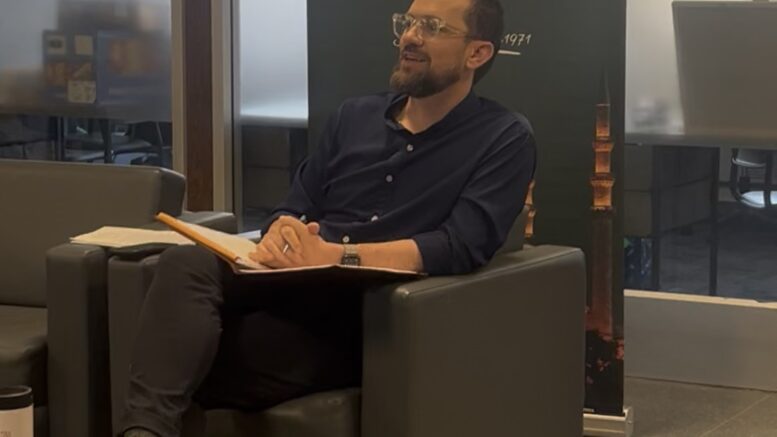
The U of M Muslim Students’ Association (MSA) launched its new book club last week with a discussion centred on
the question, “What is education for?”
The first meeting brought together students and community members for an informal, discussion-based session in
the Arts Lounge. This session was led by U of M professor Jonathan Jenner. Rather than assigning a full book,
participants examined a short reading titled, “What is Education For?” by ecologist and academic David Orr.
“I really adore that question,” Jenner said. “What is education for? Why are we here? What are we doing? And those
are the kinds of things I want us to think about and talk about today.”
Jenner emphasized that while university education is often framed as workforce training, he believes that focus
can overshadow deeper goals.
“I get frustrated with the idea that education, especially university education, is simply for training workers,” he
explained. “I wish we were more concerned with values, with ideas, with basically questions of freedom.”
The session opened with a group activity in which participants were divided into small groups and given scenarios,
such as recently freed enslaved people or factory owners, and asked to imagine what an education system would
look like for each group.
Bareera Kamran, MSA secretary, said the activity helped ground the discussion in real world contexts.
“It made us think, ‘What can be different educational systems? What can be different goals that you’re trying to
meet with educating different types of audiences?’” Kamran said. “Then we came together, [shared] our ideas, and
then we [delved] into the reading.”
The book club is a new initiative introduced this year by MSA student life manager, Arifah Gheesah, with the goal of
creating an accessible, low-pressure space for discussion.
“She wanted it to be a casual space where we read one article or one chapter from a book at a time, or any news
article or something that’s going on right now,” Kamran explained.
Faisal Shamim Zahed, MSA president, said the book club fills a gap in the organization’s programming, which has
usually focused on religious and social events rather than academic events.
“Our thought behind it was also to encourage our student body to learn and to read books and to read articles,
which nowadays [is] very rare.”
He also outlined how readings are selected and approved.
“[Gheesah] usually speaks to the speaker, and she gets some info about which book they want to read,” Zahed
shared. “And then she brings it up to the table with the [executives].”
Zahed said the executive team reviews the content before approving it.
“We confirm the contents and everything because we have to make sure that whatever MSA is doing, it is aligning
with the Islamic code of conduct,” he stated.
“I personally have learned a lot of things from the previous lecture,” he explained. “I recommend everyone at least
to join one of these sessions to just see how you feel.”
The MSA plans to continue the book club either bi-weekly or monthly, depending on interest and capacity.
MSA book club launches with questions on education
Book club brings students together to reflect on learning beyond grades and careers