Peace signs, bell-bottoms and long hair — the Swinging Sixties can be described as one of the most iconic and influential decades in recent history. With events such as the civil rights movement and the birth of counterculture, this decade saw dramatic shifts in almost all aspects of society, and the music scene was certainly no exception.
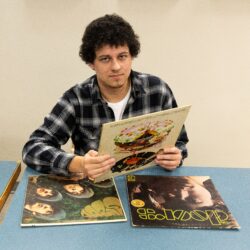
Jamie Sampson is the host of Sixties Expressions, the only radio show in Winnipeg that exclusively features music from the ’60s. He started the show when he grew tired of the repetitive songs on mainstream radio and wanted to tap into Winnipeg’s legacy as a musical mecca.
“All mainstream radio stations in Winnipeg, like 94.3, 99.9 [and] 100.5, play the same music every day. It’s the same music on a shuffle, and it’s because they will come out with a set list [to] guarantee it has 35 per cent of Canadian content […] To me, that seemed boring. I don’t need to hear the same Canadian ’80s song […] again for the fourth time in a row,” he said.
“I also noticed that Winnipeg doesn’t have a ’60s radio show, which is weird because Winnipeg was actually considered a music capital in the ’60s. We had a music revolution. Many bands emerged, such as the Guess Who, Chad Allan and the Expressions, the Jury, Sugar ‘N Spice and Neil Young.”
The fourth-year history student explained there were many garage bands in Winnipeg during that era, including the Squires and the Deverons, which featured renowned artists Neil Young and Burton Cummings, respectively. Sampson described that the surf rock, British Invasion style of these bands was vital for “paving the way for musicians in Winnipeg in the ’60s.”
Leonard Cohen, best known for his hymn “Hallelujah,” even performed twice at the U of M in the ’60s — first as a poet and then as a singer-songwriter in Taché Hall — attesting to Winnipeg’s vibrant music scene at the time. A photograph of him performing can be found in the basement of the Helen Glass building.
Speaking more broadly, Sampson commented that ’60s music was like a soundtrack to the sociocultural upheavals of that period. Music turned into something much more experimental and rebellious, and themes such as anti-war sentiment, racial segregation and communism began appearing in songs.
“It was no longer music like most of the ’50s, which had dry, boring lyrics [and] simple songs about love. Now there was lyrical depth. Now people were experimenting in terms of the music-making process and output of their songs. There were no genre bounds. People were trying different things out [and] different instruments,” said Sampson.
He highlighted the Who’s “My Generation” as an example. With lyrics such as “This is my generation /
This is my generation, baby,” and “Why don’t you all fade away,” it is easy to spot its counterculture sentiments and resistance against tradition.
“[The song] is about going against your parents’ generation that grew up in the Depression and that went through [the Second] World War. It’s essentially going against everything that they said and believed in. It’s leaving your hair long and it’s wearing tattered sneakers. It’s completely shaking up the status quo,” he said.
When asked about his favourite record, he struggled (as any music aficionado would) but settled on “Something” by the Beatles — a slow ballad written by band member George Harrison. He also recommended “San Francisco” by Scott McKenzie, “Time of the Season” by the Zombies and “Wouldn’t It Be Nice” by the Beach Boys.
It is hard to overstate the impact of music from the ’60s. For instance, six decades after its initial release, Connie Francis’s 1962 song “Pretty Little Baby” went viral this year and was used in more than 22.5 million TikTok videos. According to Sampson, this revitalization can be explained by advances in technology.
“There 100 per cent is a ’60s revival going on, and some of it can be, in part, due to the vast streaming services that we have now. In the ’60s […] if they weren’t listening to songs on the radio […] they were going to the record store. And there would be listening booths [where] they could hear a song for the first time ever, and if they thought [it] was cool, they would buy [the] record,” he explained.
“Nowadays, I […] could go on Spotify for hours, and I could discover albums and artists that I never would have heard of [such] as “Ladyfingers,” an instrumental piece from the album Whipped Cream and Other Delights by Herb Alpert and his Tijuana Brass Band, [which] I believe, got 134 million streams through becoming popular on TikTok.”
Sampson added that Hollywood has also picked up on the oldies renaissance in recent years, releasing biopics of artists such as Elvis Presley and Bob Dylan, starring Austin Butler and Timothée Chalamet, respectively. A four-part biopic on the Beatles is also coming out in 2028, starring acclaimed actors Paul Mescal and Barry Keoghan, among others.
“It’s interesting to see the lasting legacy of ’60s music. It completely changed everything. It shook it all up, and it was awesome,” Sampson enthused. “The ’60s is, if you ask me, the best decade for music.”
Sixties Expressions is hosted on 101.5 UMFM every Saturday from 10 a.m. to 12 p.m. For more information, visit umfm.com/programming/shows/sixties-with-sampson. Connect with Sampson on Instagram @sixties_expressions_umfm or at [email protected].