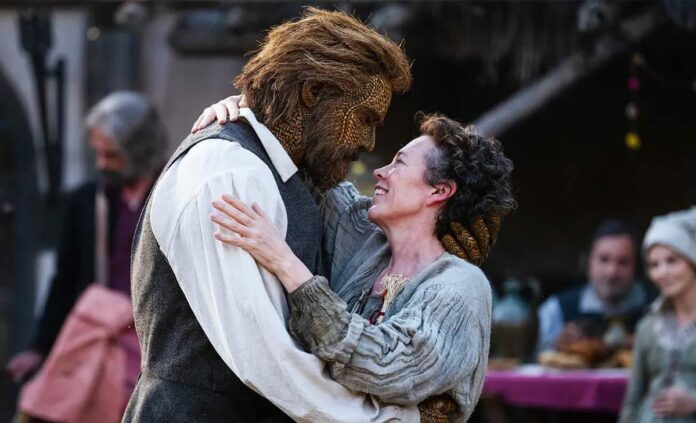
You may ask yourself, “Why is the Manitoban publishing a review of an R-rated movie from 1971?” Well, reader, this is the first time that The Devils has ever been available to be seen in its entirety. It combines a period religious drama with the over-the-top sexualization and horror-filled exploitation characteristic of the era, so it was heavily censored for blasphemous imagery upon its release. Now, after five and a half decades, it has finally been restored to its original form.
It is an incredibly blasphemous film, to be clear. The amount of crazed sexual desire the nuns so viscerally embody is beyond normal for movies in 2026, let alone in 1971.
If you can look past that, what immediately strikes the viewer as the film begins is the grandiosity of its costuming and set design. It truly captures how opulent French nobles and clergy would have appeared in the 17th century. Almost every costume is layered with intricate gilding and lace, apart from the nuns’ habits. A good part of the film takes place in Loudun, a city fortified with massive white walls. It is not simply a forced perspective — the actors were standing inside it. I spent the entire screening wondering how they could have possibly built such a grand set to film in.
Another surprising aspect, right off the bat, is the film’s humour. There are many depictions of the characters’ sexual desires that are so campy you cannot help but laugh.
The Devils is more than an exploitation movie. It is a film about corruption. More specifically, a lesson about the dangers of mixing church and state. It features a morally complex central character, Father Grandier. He starts off wrapped up in shady scandals of his own making but spiritually reforms himself as time goes on. The conflict arises when a clique of other clergymen and the king threaten Grandier’s absolute power over the city of Loudun. Meanwhile, unbeknownst to Grandier, a nun develops rabid feelings toward him and drags all the sisters into her frenzy — a development the clique manipulates in order to advance its agenda to strip his power.
Eventually, Father Grandier gets caught in a trap entirely out of his control. Despite his previous scandals, he had nothing to do with the nuns. He is accused of initiating their lust through witchcraft anyway, because no matter what spiritual reform he tries to undergo, he is still just as much of a political target as he is a priest. The Devils demonstrates that the defendant’s evidence does not matter in a political climate ruled by conspiracy theories and hysteria.