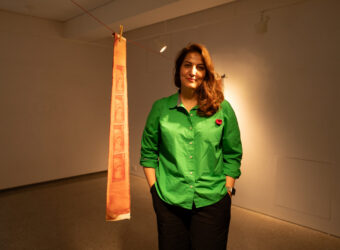
Maryam Bagheri, who resides in Winnipeg with her husband and two children, has not been able to visit her family in Iran for the past nine years.
She keeps in contact with her mother with video calls, which inspired Bagheri to create an anthotype portrait of her using turmeric. The portrait is reproduced on strips of canvas and hung around the gallery.
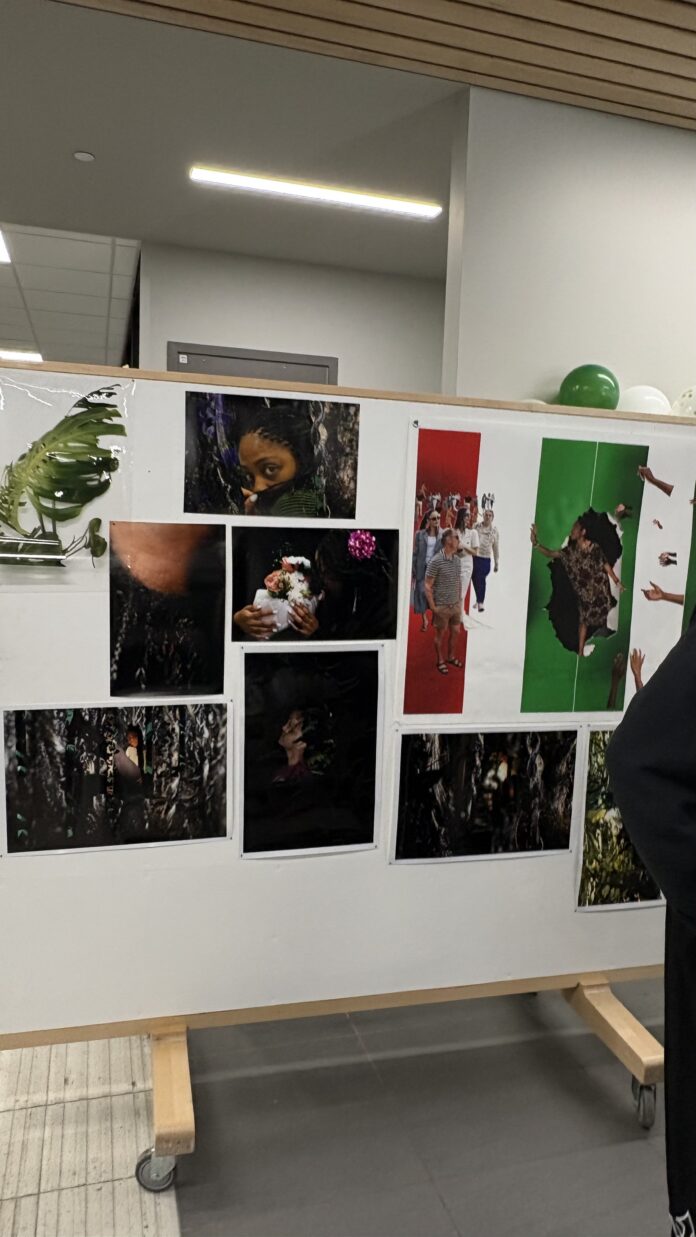
Bagheri is one of the artists whose work is on display in Dwelling in Thresholds, an exhibition at the School of Art Student Gallery presented on Aug. 26 showcasing works by five Iranian students and graduates from the school of art.
“The portrait is actually screenshots of my mother and I talking on the phone,” she said. “It was only through the cell phone’s camera, just seeing each other through these screens.”
“My mother, my brothers, my father, they all live in Iran,” she added. “It’s been a lot. This work is talking about that distance from home, from my family, especially my mother, [who] was sick for a long period, and I couldn’t be there for her.”
Ali Bayat, the curator of the show and a PhD student in film studies at the U of M, explained that the show is all about home in a broad sense.
“It’s about […] what makes home, and all these questions related to very foundational components of one’s identity, especially after geographical or cultural displacement,” he said.
This exhibition was conceived in response to the upheavals and crisis in Iran over the past year, said Bayat, and it also deals with the experience of being worried about home while watching from afar.
Another piece on display is a ceramic mosaic by MFA student Sara Sattari depicting a feminine body riddled with bullet wounds.
“This picture, if I’m not mistaken, is presenting an actual picture that became mainstream all over [the] place after [the] January crisis,” the curator said. “If you come from that bubble of Iranian social media, that image makes sense to you because it definitely brings up a lot of memories.”
Bayat, also originally from Iran, described a complicated relationship with his homeland. It has given him his language and traditional family structures and defined who he is as a person.
“At the same time, this is entrenched in so [much trauma]. So it’s not all rainbow and roses,” he said.
“[Home is] a very complicated combination of negatives and positives with all their force, so destructive and constructive at the same time, but a phenomenon that needs to be studied,” he added. “[It is] a phenomenon that is not personal. It’s very communal.”
Bayat stressed that Dwelling in Thresholds is not only about Iran, but the diasporic experience in general.
“I think anyone who is concerned about this idea of being at home, who’s concerned about the idea of even identity in general, would probably take something personal out of this exhibition because all these artists are doing a very deep dive, honestly, within themselves to search for the roots of their personal anxieties.”
Dwelling in Thresholds is on view at the School of Art Student Gallery until Sept. 9.