

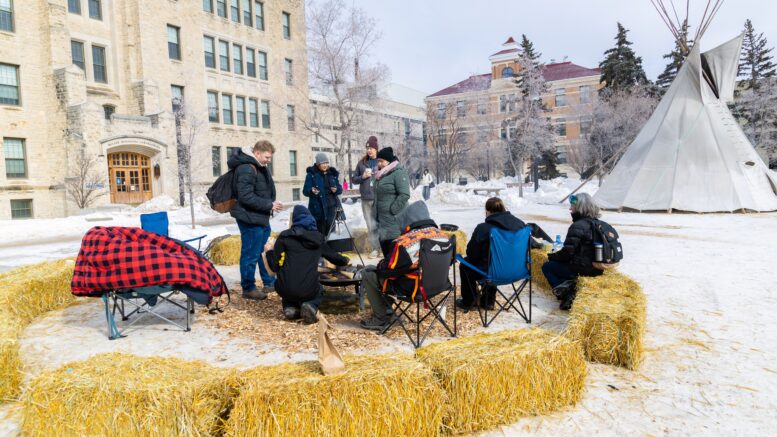
The Elders and Traditional Peoples Gathering returned to the U of M on March 5 and 6, bringing together Elders, students and community members for two days of cultural teachings, ceremonies and community connection.
The Elders Gathering first began in 2002 through the university’s department of Native studies, now known as Indigenous studies.
Now in its 20th year, the gathering provides an opportunity for Indigenous Elders and traditional knowledge keepers to share teachings with younger generations and the wider community.
Vanessa Lillie, director of cultural integration with the office of the vice-president (Indigenous), said this year’s theme, Ancestral Voices Guide Us, highlights the importance of ancestral guidance.
As a core of the gathering, Lillie mentioned that “Elders play a really significant role in Indigenous families, and they’re the ones that we rely on for guidance, and reminding us of our oral histories, and telling us the stories of our history and culture and language.”
Lillie acknowledged the increase in attendance, with hundreds registering this year. “We needed to move into larger spaces to accommodate everyone,” she said.
Outdoor cultural spaces were an important part of the gathering.
Two teepees and a sacred fire were set up outside, with fire keepers remaining by the fire continuously during the event.
The program featured keynote speakers, presentations and visiting spaces where attendees could listen to teachings or connect to others.
She explained that the gathering was originally designed to strengthen relationships between Elders and young people.
The gathering also featured an Indigenous Student Makers Market where students could showcase and sell their artwork and crafts.
Savannah Moon, one of the student vendors, said the gathering allows people to celebrate Indigenous culture while learning from traditional knowledge keepers.
Moon sells a variety of handmade items, including beaded jewellery, wristlets and ribbon bows decorated with jingle cones. She said the small business helps support her financially while she is in school.
Another booth at the gathering highlighted the work of Women Helping Women Beadwork, an initiative run by Sandra Burling that supports incarcerated women.
At the event supporting the organization was Mackaila Bruce-Tapley, who said the organization sells beadwork created by women in correctional centres. “All the beadwork that the women make and sell, that money goes toward them for bail or after bail, and also goes toward them if they need resources while they’re in incarceration,” Bruce-Tapley explained.
She described Burling’s work as deeply impactful for the community.
“Sandra is an incredible woman,” she said. “What she does for the community is amazing.”
Jamie O’Neill, another vendor at the market, was representing her family business, 15 Feathers.
O’Neill explained that the business is a collaborative effort among the women in her family to “help spread things that [they] love.”
One of the products they sell is an Action is Required t-shirt connected to the Truth and Reconciliation Commission’s (TRC) 94 Calls to Action.
“On the front, it says, ‘Moving forward requires action,’” O’Neill stated. “On the back, we print whichever of the TRC’s [Calls to Action] really speaks to the customer.”
The idea behind the shirts is to encourage individuals to act in their own way and be able to focus on one action, rather than all.
“94 is too much for any one person, but if we each choose one and move one forward, then one day we’ll get there,” she shared.
Behind the scenes, dozens of volunteers help coordinate the event and assist the Elders throughout the gathering.
Meghan Young, cultural integration lead for the office of the vice-president (Indigenous), led the volunteer team.
More than 90 volunteers supported the two-day event, guiding attendees between different sessions across the university and remaining by the Elders.
“A volunteer is assigned to an Elder […] to help them over the two days with whatever they need,” Young explained.
Cultural expression was visible throughout the event. Many attendees wore ribbon shirts and skirts, garments that often carry personal or family stories.
“[Our ribbon skirts are] a piece of our culture that we wear proudly,” Lillie said.
Music and singing also played a role in the gathering’s activities. Bruce-Tapley described a moment where community members gathered to sing songs representing healing and empowerment.
As the gathering concluded, organizers hope even more students will take part in the future.
“We would love to be able to welcome students from across the university in larger numbers next year,” Lillie said.
