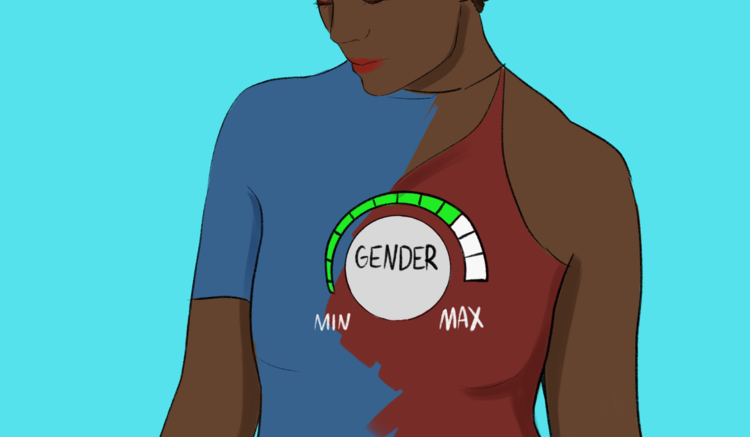
How much of our gender expression is choice, how much is choreography?
In the fall of 2025, I spotted someone on campus whose clothing seemed unusually bright, in contrast to the subdued and “calm” hues of a Winnipeg semester. The colours were vibrant and the makeup deliberately loud. The contrast was stark. My first thought was simple — that’s too much.
I didn’t say it out loud. But I recall my reaction was immediate.
A few months later, at a conference dinner, I found myself wearing a gown. Now, I am usually a jeans-shirt-and-sneakers person, confident in understated comfort. But that evening carried its own expectations. I let a friend style me. I wore the makeup. I put on the heels. The compliments came and I did not feel out of place. If anything, I smiled all through the event, even though I had felt and complained many times to her that “it was too much.”
Two different places. Two different required scripts. But, for both, gender felt less like an instinctive self-expression and more like a choreography, something we ought to follow.
We sometimes discuss gender as if it can be a pure expression and arises from authenticity. Be yourself. Dress how you want. Show up as you are. And yet, most of us intuitively understand that not every version of ourselves fits every room.
Campuses have a distinct aesthetic vibe. And from my observation, in Winnipeg’s fall, the vibe is practical — neutral colours, denim, hoodies and sturdy, functional shoes built for changing weather. The atmosphere is relaxed, casual and almost utilitarian. Against that backdrop, brightness reads loudly — not necessarily wrongly, but noticeably.
On the other hand, I think dinner parties operate at a higher pitch. They welcome elevation. Glamour is not excess there, it is alignment. For example, in my case, a gown and makeup did not disrupt the room, rather, they blended in with the space. But that alignment was learned, acquired, encouraged through persuasion and reassurance — “Hey, Peace, it’s not too much. It’s just right. It’s appropriate. You look good. Enjoy it.”
What unsettled me about my own reaction to the fall campus event, upon reflection, was not the brightness of the clothing. It was the speed with which I recognized and registered it as misaligned. As though I carried, unconsciously, a mental decibel scale for acceptable presentation. As if I knew, without ever being told, how loudly or not femininity, in this case, should speak in a particular space.
That realization forced a harder question — who sets that volume? Why did I think that way?
Sociologist Erving Goffman described social life as a series of performances, with each of us managing impressions depending on the stage we occupy. We adjust tone, posture and even vocabulary depending on whether we are in a classroom, at a job interview or at dinner with new faces. It would be naive to pretend clothing and gender presentation are exempt from that same negotiation.
But acknowledging performance is different from interrogating its pressure.
At the conference dinner, no one forced me into a gown. I agreed, although not without some convincing and a few moments of checking the mirror. I was also curious to see myself differently. I enjoyed the affirmation. Yet it would be incomplete to ignore that the invitation to “switch it up” was gendered. I was not advised to explore with androgyny or go further into my comfort zone. The expectation of the evening leaned in one direction — a more feminine, more polished, more visible direction.
I complied, not because I lacked confidence, but because I came to understand the script. This is not to say that wearing my usual pants and sneakers would have made me feel out of place. But I would have been. The room had a clear aesthetic, and my gown aligned easily with it.
And perhaps that is the point. Scripts are rarely written down. They are absorbed. We learn without noticing how much effort a space rewards. How much brightness it tolerates. How much deviation it registers. Over time, we learn what seems expected the next time we enter a similar room, what belongs and what feels out of place.
The individual I noticed in the fall did not violate a rule. There was no dress code. Vibrant colours and elaborate pinky makeup that matches your pink outfit are not prohibited. The only thing disrupted was harmony. The quiet, collective agreement about how campus typically looks. My reaction revealed that I, too, am attuned to that harmony.
So maybe the issue is not that someone was “too much.” Maybe it is that we are deeply trained to detect when someone exceeds the “aesthetic expectations of a room.” And perhaps that reveals more about us than about them. If gender is self-expression, then it is also social negotiation. It moves between authenticity and adaptation. Between environment and instinct. Between who we think we are and who a room invites us to become.
We all perform in various ways, therefore the question is not whether we should. The question is whether we recognize how frequently the performance is subtly staged for us, and if we ever stop, mid-judgment or mid-adjustment, to ask — is this what I want to express or what this space has choreographed for me?