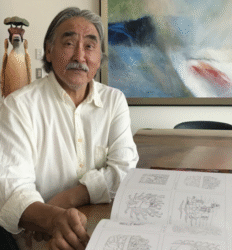
Abraham Anghik Ruben. Supplied by WAG.
WAG-Qaumajuq’s exhibition of works by Inuvialuit (Inuit) artist Abraham Anghik Ruben has recently been extended to run through May 31.
One of Canada’s most celebrated contemporary artists, Ruben was born in Paulatuk, Northwest Territories. Until the age of eight, he lived a traditional Inuit lifestyle, migrating as the seasons changed. This was halted when he was taken away and sent to a residential school.
In 1971, Ruben began to reconnect with his past while attending the Native Arts Centre at the University of Alaska. After working in various art mediums throughout the 1970s, he caught the attention of many Canadian art dealers.
Since 1986, Ruben has lived in Salt Spring Island, British Columbia, with his wife and children, where he continues to work.
Curator Heather Campbell said that the exhibition did not start with a set theme.
“It was meant to be a review of 50 years of Abraham’s artwork,” she explained. “When I started, there wasn’t a theme. It was part of my role as the curator to figure out what a loose theme would be and then section it out from there.”
After looking through Ruben’s artwork, Campbell found that Ruben had an interest in mythology from both the Inuit traditions and from Nordic culture. This interest is attributed to a family connection — his mother’s aunt, Paniabuluk, assisted Arctic explorer Vilhjalmur Stefansson on his exhibitions and later married him.
“[His work] was a way to find commonalities between the two [mythologies] and to explore that,” Campbell stated.
The exhibition is the first solo show in Qaumajuq’s Qilak gallery. Qaumajuq, Canada’s Inuit art centre, is dedicated to the gallery’s Inuit art collection.
“It’s so important that the space was developed with Inuit art [and] Inuit culture in mind,” said Campbell. “[It] was loosely inspired by the environment of the Arctic […] It was a lot of fun trying to explore how to use that space.”
Campbell stated Qaumajuq’s spacious atmosphere proved useful in setting up the exhibition.
“A lot of his more recent works are large-scale,” she explained. “It was perfect that we had so much space to play with in that gallery. There’s not a lot of Inuit artists that are working at a monumental scale like that, so just having that ability to place things very freely and find a way to create that relationship between the space and the works was a lot of fun.”
When asked if she had a favourite artwork in the exhibition, Campbell highlighted Ruben’s prolific body of work, describing the amount of work that he has done over the past 50 years as “mind-boggling.”
“Being able to select from such a huge collection of works and from various decades and […] themes, it was a monumental task trying to narrow it down to the pieces that we do have,” she reflected.
Campbell finished by highlighting that those who visit the exhibition will not only get to view Ruben’s artwork but hear him explain the significance and meaning behind each piece through QR codes linked to audio recordings.
“You can actually hear him talk about the piece in his own voice, in his own words, and I think that is just so special,” she said.
The Abraham Anghik Ruben exhibition is open at the WAG’s Qaumajuq gallery through May 31. For more information on the exhibition, visit wag.ca. For more on Abraham Anghik Ruben, visit abrahamruben.com.