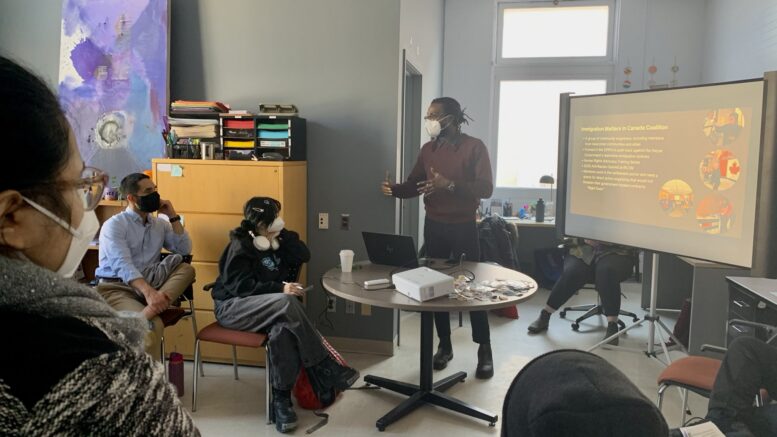
The Social Justice Hub’s teach-in for January, titled Migrant Justice Organizing, took place on Jan. 27 and was co-hosted by Migrante Manitoba, Anakbayan and the Social Planning Council.
The Social Justice Hub has a monthly teach-in where they discuss different social justice issues while bringing university staff, faculty and community partners to co-host sessions. This is a resource on campus for students who are interested in social change and community work.
Mandalyn Unger, Social Justice Hub coordinator, explained how those teach-ins are for students to learn how to do community work more effectively and sustainably. “We’re really an office that focuses on moving students from identifying problems to then taking action on addressing them,” they said.
For January’s event in particular, the hub brought local community organizations that are working on the issue of migrant justice organizing so that students could learn from them and get involved. Unger added that these organizations can also learn directly from students about the challenges emerging in an increasingly anti-migrant political climate.
“I think especially with what we’re seeing happen in Minneapolis and the complicity of Canadian companies that are funding ICE either through the sale of tanks or other resources, we wanted to make sure that we were talking about how we can make a difference in that fight here locally,” Unger said, reflecting on the economic barriers that are applied to international students and the impacts of anti-migrant rhetorics.
During the event, attendees were able to hear presentations from the three organizations. Various topics were discussed such as the importance of student leaders in social justice movements and mass movements and the history of colonialism and capitalism and its impact on the Philippines and on migration for Filipino people into Canada.
The Social Planning Council talked about Bill C-12, the Strengthening Canada’s Immigration System and Borders Act, which aims to enhance border security and the Canadian immigration system. “It’s a huge bill that severely impacts migrants, newcomers [and] refugees, but also has implications for citizens,” Unger stressed.
Unger shared how Bill C-12 expands the surveillance state and the information that can be shared about people between government agencies, which invades people’s privacy. It implies power to the government to mass-cancel immigrant applications. They believe that we are seeing as much anti-migrant rhetoric and policy being put forward as we are in the U.S. Unger explained there is a “deportation machine” that is being built by Bill C-12 which will be mass-deporting people, regardless of the impact that will have on their lives.
The Migrant Rights Network, a cross-Canada alliance, is leading a campaign to ask people to write to their senators who are the last chance to stop this bill. People who want to contribute to that change can go to migrantrights.ca to write a letter to their senator.
“We do have the power to change the circumstances that make our lives so hard, and we have a much better chance of doing that if we work together than if we work alone,” Unger said, reflecting on the discussions that students had during the event.
With current happenings in the U.S., Unger is convinced empathy for our neighbours is necessary and want them to be safe and secure. An issue need not personally impact us to care about it. “Whenever we see state violence being enacted on a more marginalized or vulnerable group, we need to understand that it will never stop there,” they added.
“Our struggles are linked,” Unger said. “There is strength in […] working together, [and] we can support each other’s fights.”
Canada is a multi-cultural country, and it is important we know who we live next to, who we work beside and who we go to school with and build personal relationships with. Our neighbours have all levels of immigration status and hold all kinds of identities. “When it comes to resisting fascism or resisting state suppression, your neighbour is the most powerful ally,” Unger said.
The Social Justice Hub remains a safe space for students to facilitate community organizing. Students can find out at umanitoba.ca/community-engaged-learning/social-justice-hub and can email Mandalyn Unger at [email protected] for more about student organizing for migrant justice.