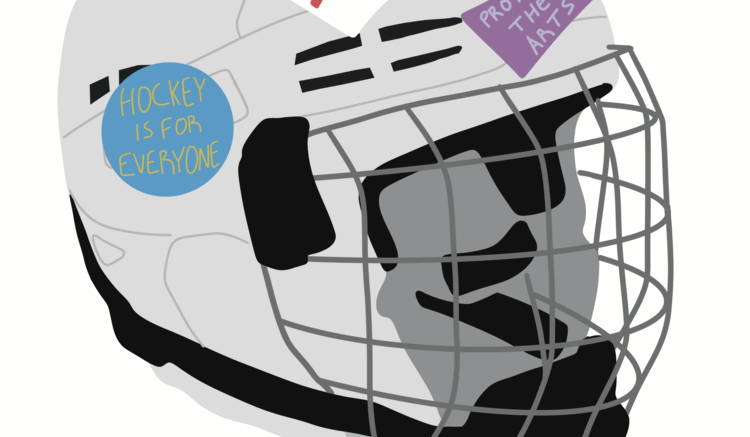
I am used to an alarm clock going off at an ungodly hour, then getting hauled into a freezing rink by 8 a.m. Not to play hockey, but to watch my brother play the sport that has become a cornerstone of his life.
Alongside the joy I get from seeing him play this long-held Canadian tradition, this holiday season has felt heavy. Not in the usual end-of-year way, but in a deeper, emptier way — like the ground has fallen out from under us but we are supposed to pretend it is normal.
Across North America and beyond, the “anti-woke” wave has hit a new peak, fully escaping the confines of comment sections and increasingly influencing public policy. We have seen attacks on diversity initiatives intensify, immigration become an all-purpose political weapon and trans people, day after day, legislated out of more aspects of public life.
And then, Heated Rivalry arrives as a reminder of why representation must be fought for and celebrated every day.
The story behind the show is already special to me. Heated Rivalry is adapted from a novel by Nova Scotian author Rachel Reid. As a Nova Scotian myself, it matters more to me than many people understand. When you are used to seeing “Canadian content” usually meaning Toronto or Vancouver, a breakout project with roots closer to home hits differently. It feels akin to being seen and proves that stories from here have the power to travel.
I am well acquainted with the smell of wet gear, cold air, the sound of skates cutting into ice and the way a rink can feel like its own little world. I also know the culture that comes with it — the parts people romanticize and the parts that make you bite your tongue.
Hockey can be beautiful, but it is also stubbornly conservative, obsessed with toughness, averse to vulnerability and quick to police anything that looks different. In recent years, we have seen how something as small as pride tape or warm-up jerseys can become a flashpoint, as if basic support for queer people is too political for the sport that is supposedly “for everyone.”
This is why Heated Rivalry matters. For those who have not watched it yet, the premise is simple but it is also deeply tied to the beauty and pain of the time we live in. Two elite hockey players, Shane and Ilya, meet as teenagers, become fierce rivals, and fall into a secret relationship that stretches across years, teams and countries. It is a romance, yes, but it is also a story about power, image and the cost of hiding. It is about how systems shape people and how those people still find each other inside those systems.
A love story set in the hockey world might sound like escapism, but I think it is the opposite. In a moment where our lives are increasingly narrowed to issues of trade and military prowess, this show insists that love, curiosity and vulnerability are not side stories, but the main plot. It treats tenderness like something worth writing, filming and funding.
It also does something Canadian television is known for. It is raw, less glossy and more willing to sit in discomfort. It is less interested in perfection and more interested in showing what people do when they are scared but still trying.
There is another layer here that we should not skate over. Productions like Heated Rivalry exist partly because Canada chooses, through policy and tax credits, to support domestic film and television. This show received assistance from programs like the Canadian Film or Video Production Tax Credit, meaning public revenue helped make it possible.
“Taxpayer-funded television” can be an easy punchline in our increasingly individualized world, but I am happy to pay taxes when governments use them to invest in public goods, support vulnerable Canadians and reduce the costs people should not have to carry alone. And yes, I want them to support Canadian arts and culture.
Because culture is not decoration. It is infrastructure.
When governments and media tell us the only thing that matters is the crisis of the moment — whether that is inflation, trade or security — it becomes easier to cut everything else quietly. Arts funding gets framed as frivolous. Public broadcasting becomes a target. Grants get treated like waste. That is not an accident. If you can convince people that imagination is optional, you can shrink public life until all that is left is fear and consumption. Once those supports are gone, they are difficult to get back. People move away, industries hollow out and whole regions lose the ability to tell their stories.
Heated Rivalry is exactly the kind of story that critics of public support would call “unnecessary” — a queer hockey romance, a “nice-to-have.” But it is also exactly the kind of story that proves why we need the arts, especially now. It makes space for people who are constantly told to be quiet. It shows that Canadian stories can be bold, not just polite. It takes a sport that has often been used to enforce one narrow version of masculinity and asks what happens when those outside that version refuse to disappear.
The streaming service Crave has already renewed Heated Rivalry for a second season, and the lead actors have said they are signed on for three. It is a reminder that Canadian work can break through on its own terms, without leaving representation behind.
Shows like this reach the screens because writers, crews and communities build them, and because there are systems that make creative risk possible. It is easy to call that spending frivolous until you notice what disappears when it is gone. More imported stories can flatten us into passive consumers, with fewer chances for people on the margins to be seen.
If we want Canadian stories that feel specific, honest and brave, we must treat those systems as essential.