

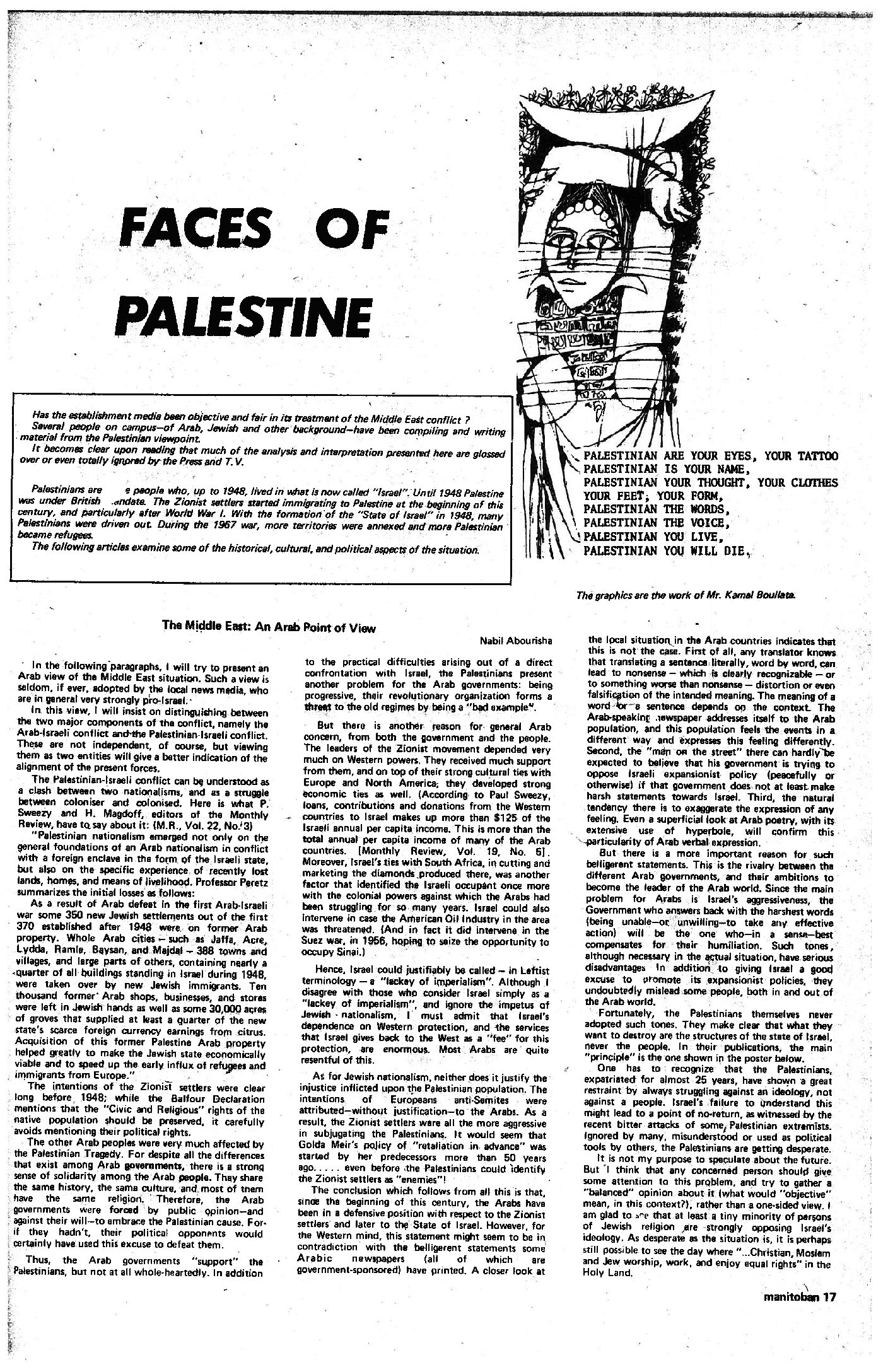
Tier Building will open its doors on Jan. 22 for an on-campus event titled Faces of Palestine, 1972: From a Document in the Manitoban to the Current Crisis. The event to be held at room 307 will feature presenter Rachad Antonius, U of M graduate and retired professor.
Antonius earned his master’s degree in mathematics at the U of M between 1970 and 1973. Before he retired in 2021, he was a full professor in the department of sociology at the University of Quebec in Montreal. Antonius “is an expert on the Israeli-Palestinian conflict, contemporary Arab societies, Arab uprisings, political Islam and Arab and Muslim minorities in Canada.” He is an author of many books, including his recent publication, La conquête de la Palestine. Antonius is also a frequent commentator on Middle Eastern events on networks such as France 24, CBC, BBC and Radio France International.
In 1972, he helped publish a dossier of articles in the Manitoban titled Faces of Palestine, which was produced with contributions from a number of people including Arab and Jewish students, as well as anthropologist Louise Sweet. The dossier addressed a range of topics, including the colonization of Palestine, the broader Israeli-Arab conflict and Palestinian art and poetry by the renowned Palestinian poet Mahmoud Darwish. It was released less than five years after the Six-Day War when increased militancy started in Gaza and the West Bank.
This document, serving as important groundwork for discussing the topic of Palestine, will be presented at the event to discuss campus activism on the issue of Palestine from the 1970s to the present.
Jonah Corne, an associate professor in the department of English, theatre, film & media and organizer of the event, was contacted by Antonius after writing about Palestinian activism on campus. Antonius then shared the 1972 dossier with Corne, who said he was fascinated by it.
Corne believed the dossier Antonius helped publish can contribute to building institutional memory around campus activism on Palestine, particularly in light of the recent rise of encampments across North American campuses and broader activism that has shaken higher education.
While a nominal ceasefire is currently in place in Palestine, human rights violations continue, including restrictions on humanitarian aid and barriers faced by medical and relief organizations. With winter conditions in Gaza, many displaced residents living in tents remain vulnerable, and reports indicate deaths linked to hypothermia.
“People have a limited attention span for catastrophes,” Corne said, emphasizing the importance of paying attention to what is happening.
In 2023, Arij Al Khafagi, president of the U of M Nursing Students’ Association, was suspended from her program after she criticized the Israeli military’s actions in Gaza on her social media. Around that same time, many people were losing their jobs and being punished in many different ways for speaking up against the genocide.
“It’s really, really unfortunate that this climate of fear keeps people from speaking out about really important things,” Corne remarked. He stressed over the fact that although Palestine is a small place and it is Palestinians who are suffering, this situation bears a larger symbolic meaning of the continuation of Western imperialism in the Middle East, the complicity of Western nations and much more.
“It’s possible to make a difference,” Corne said. Many students and professors have been fighting for the university to divest from companies that give support to Israeli ventures and enable genocide. “If there is a way that you can make a difference, I think you have to just make that effort.”
The event with Antonius will give attendees an opportunity to hear a different perspective and history of Palestinian activism on our campus and draw connections from the past to the present. Corne hopes the event will encourage people to stand up for what is right and deepen their understanding of the situation in Gaza.
The event is free and requires no registration. More information can be found on the faculty of arts Instagram page @umartsfaculty.
