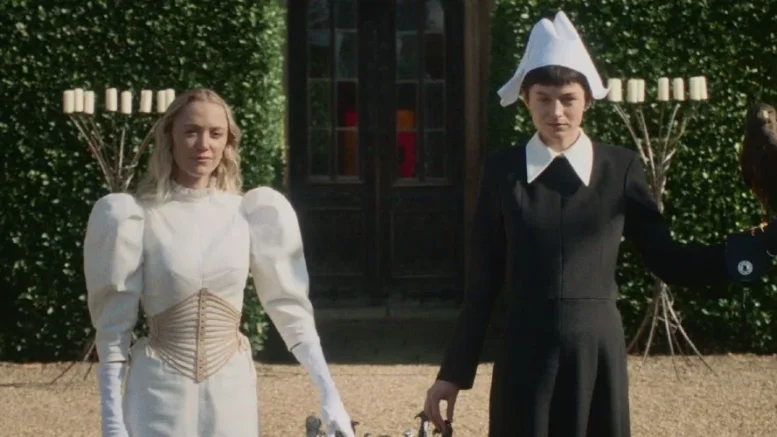
Director Julia Jackman’s 2025 film 100 Nights of Hero was released in Canada last month. It follows the newlywed Cherry and her close housemaid, Hero, as the young attractive Manfred attempts to seduce Cherry as part of a wager with her absent husband, Jerome. In secret, Jerome has yet to consummate their marriage, despite pressures to bear children from their bird-themed church. Throughout the film, Hero recounts the story of a woman who was oppressed by men because of her literacy.
The film employs a distinct visual style, with particularly avant-garde costumes to depict a fantasy setting. Combined with the unconventional plot and monotone performances from the cast, the audience is left with a distinct eerie feeling. However, the prioritization of uncanniness results in a disjointed plot which abandons the stronger social politics of Isabel Greenberg’s 2016 graphic novel of the same name.
Greenberg’s original story follows Cherry and Hero as a closeted lesbian couple, where Hero recounts a series of interconnected feminist folk tales to distract Manfred, who threatens to sexually assault Cherry as part of a wager with Jerome. The wager came about when Jerome proudly boasted Cherry’s perceived chastity and devotion to their bird-themed church, a tie-in to Greenberg’s previous work.
The folk art style is reminiscent of woodcut illustrations, and the events are narrated with a quirky mid-2010s wit and repeated emphasis on love’s importance to the human experience —but the frontmost lesson of the story is unquestionably that women will always be objectified in a patriarchal society, no matter what a woman accomplishes.
In the film, Cherry is shown to have some interest in the heartthrob Manfred that she must resist, while he uses manipulative persuasion to justify his proposition of infidelity — thus Jackman’s addition of external pressures to consummate the marriage. Whereas in the graphic novel, Cherry is clearly disgusted and in fear of the menacing Manfred. It becomes an entirely different story when the outcome is dependent on Cherry’s choice, rather than her and Hero’s ability to protect themselves from danger. In sanitizing the fundamental conflict of the plot, the precise message of the film becomes less clearly communicated beyond a vague criticism of patriarchy.
Nonetheless, the film is an impressive production in terms of technical skill. The costumes and sets made the fictional world feel whimsical. The scenes depicting Hero’s story also conveyed an ethereal mood through its cinematography, but this adaptation could have been so much more.