
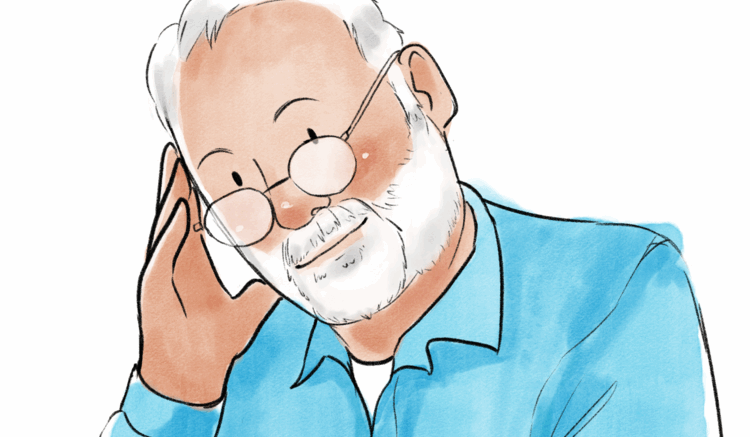
Robert Munsch, the famed Canadian children’s novelist, has always been one of my favourite authors. His whimsical stories enchant me, with both his drawings and pictures eliciting a form of childhood nostalgia whenever I read his books.
If you were to ask a person who grew up in Canada if they had read a Robert Munsch book as a child, they would most likely say yes. His stories also transcend age. Despite his books being written for children, I sometimes yearn for the familiarity they always bring me.
In a world where everything is online and AI is beckoning, I find comfort in the pages of his books, The Paper Bag Princess, Stephanie’s Ponytail and Something Good. These are just a few of the books that have really resonated with me during my childhood.
Munsch is not only an author, but also a person who lived a prolific life, often going to classrooms at random and speaking to children or serving as a prize in contests and staying with families of those contest winners. Despite all these, Munsch lived a life of struggle. He was diagnosed with obsessive-compulsive disorder (OCD) and manic depression, which led to addiction problems and mental health struggles.
As a person who lives with OCD, Munsch’s diagnosis surprised me a lot. I know OCD affects people differently, and I know there is no distinguishing factor for someone who has this mental health disorder. But Munsch, being such an influential author and person, made me proud as a person who also suffers from OCD. I find myself thinking of Munsch more in recent days, a lot more than I usually would. This is due to Munsch being approved for physician-assisted suicide after previously being diagnosed with dementia and Parkinson’s
disease.
Munsch first said it years ago, “The stories will be the last to go.” Even though Munsch, as a person, is succumbing to the disease of Parkinson’s and dementia, his story and the impact of his novels will stand the test of time and will live on within the children he influenced with his work.
Munsch, despite being approved for physician-assisted suicide, continues to stay optimistic, even going as far as cracking jokes about his dying. “Hello, Doc — come kill me!” Munsch joked to the New York Times. “How much time do I have? Fifteen seconds!”
Even though Munsch, as a person, will no longer be physically with “us,” he lives in his ultimate creation, which is his books. As a person who has thoroughly enjoyed Munsch’s books all my life, I can say that I am grateful for the memories he always brought me through his storytelling. I also speak for the majority of people who also loved Munsch when I say that “We’ll love him forever.”