
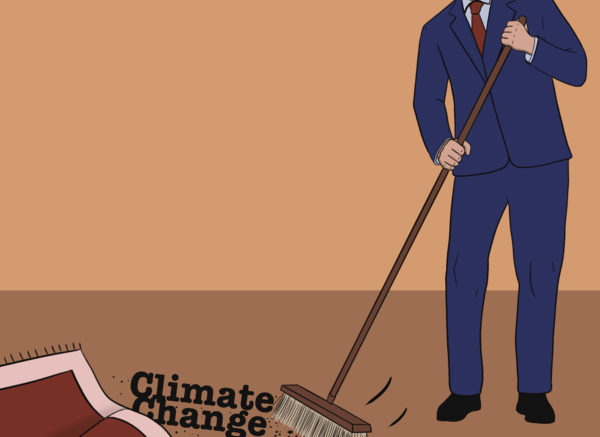
Prime Minister Mark Carney’s last-minute decision to attend the Gaza peace summit in Egypt was the diplomatic equivalent of the group project member who shows up at the end, repeats what others have already said and expects to see his name on the cover page.
It appears Carney believed that simply being visible at the summit would be enough to convince concerned Canadians he is committed to peace. However, he offered nothing new, instead repeating familiar points and continuing to call for peace, as if simply repeating these appeals might be enough to move the needle and make peace in Palestine a reality.
The lack in his leadership is even clearer when you look at a comparison like the Hague Group, a new coalition of Global South nations that assembled earlier in 2025 to uphold the rulings of international law regarding Israel’s occupation of Palestine. These nations have taken public stands on issues of peace and accountability at a time when Canada too often settles for simply showing up.
The summit seemed to reveal Carney’s preference for image over impact. For instance, in his statement, Carney called for humanitarian access to Gaza, supported preparations for an international stabilization force and emphasized strengthening Palestinian governance. But, these came with conditions and caution, never fully committing to Palestinian self-determination.
These points reflect status quo government policy rather than offer comprehensive ideas to advance peace, matching the group project analogy. Rather than taking any sort of risk or showing progressive leadership, Carney has favoured safe, non-controversial statements that maximize line-walking at the expense of Canada’s fading identity.
While the true human rights impact and legitimacy of the summit are certainly of concern — given the absence of Palestinian representation and participation, the dominance of external powers and the vague and unenforceable nature of these commitments — these issues only amplify my central point. Carney’s role was symbolic. By not even inviting the Parliamentary Press Gallery to the summit, Carney favoured potential optics over substance and failed to push for any sort of accountability.
This approach is not unique to the Gaza peace summit. Carney often promises he is all in on the project, but when the real work begins, he is nowhere to be found.
On climate, Carney has stated in his own book Value(s) that sustainability is a core principle to him, and the threats of climate change are “existential.” However, his government has yet to implement measures that align with this value he felt so strongly about.
In a recent Bloomberg interview, Carney defended his record by saying that he is focused on climate policies, as they are “likely to have the greatest impact at a time of strained resources and multiple crises.” He made this response, pushing back against claims that he is retreating on domestic environmental action. In practice, however, climate regulations have stalled or been softened in response to industry pressure and a desire to make quick changes, potentially without considering long term outcomes.
It could be argued in a time of economic crisis leaders are wise to play it safe. However, real leadership is not about avoiding difficult decisions or just going with the flow. Even when times are hard, and especially when times are hard, Canadians deserve leaders who will put in the work for thoughtful, long-term policy rather than settling for optics or temporary approval. Playing it safe may seem easier, but it does little to address the challenges we face or to rescue Canada’s identity as a respected global leader.
If Carney were truly committed, he would put in the work — he would seek out bold ideas and push for meaningful results. Canadians deserve more than a leader who wants the “grade” for showing up, without putting in the grounded work that meaningful, long-term success requires.